

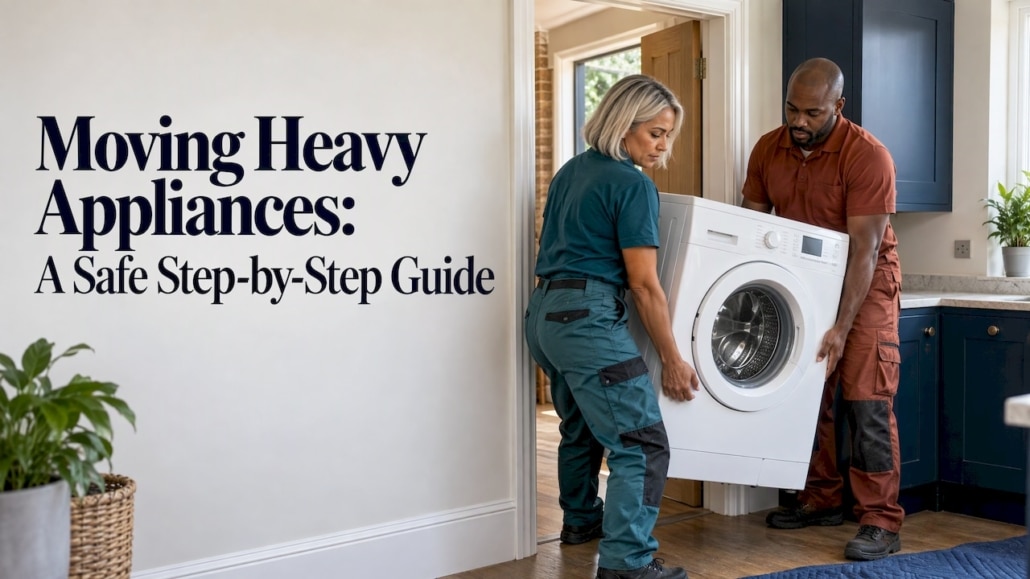
Moving Heavy Appliances: A Safe Step-by-Step Guide
The safest way to move a heavy appliance is with two people, the right equipment and a route you have cleared and measured beforehand. Never lift it alone. Strap it to an appliance trolley, protect the floor, and keep fridges upright. Leave anything gas-fired to a Gas Safe registered engineer. If you have any doubt about the weight, the stairs or the doorway, hand the job to professional removers.
This guide covers the preparation, the kit and the technique for washing machines, fridge freezers, cookers and other white goods. It also tells you what to check before you switch an appliance back on.
TL;DR
- Do not lift a heavy appliance on your own. Plan for at least one helper, and use a trolley, straps and sliders rather than muscle.
- Measure doorways, hallways and stairs first, then unplug, empty, clean and dry the appliance and wrap it to protect it.
- Keep fridges and freezers upright where you can. If one has been laid down, leave it standing before you switch it on.
- Never disconnect, move or refit a gas cooker or boiler yourself. By law that work needs a Gas Safe registered engineer.
- If the route includes stairs, tight turns or an awkward weight, a professional team is the safer choice.
Table of Contents
- Why heavy appliances need a plan
- Lifting and handling technique
- The equipment that makes the job manageable
- Preparing the appliance, the route and the house
- Moving a heavy washing machine
- Moving a really heavy fridge or freezer
- Cookers, ovens and anything gas-fired
- Stairs, tight turns and awkward spaces
- Our view: why we treat appliances as specialist items
- When to call professional removers
- Move your appliances with Taylormade
- A final checklist for moving day
- FAQ
- Sources
Why heavy appliances need a plan
A washing machine, American-style fridge freezer or range cooker is dense, awkward and has no good handholds. The risks are to your back, to your hands and to your floors and walls. Manufacturers say as much. Bosch UK warns that moving a fridge freezer carries a risk of injury if it is not handled correctly. It advises against lifting the appliance on your own and says to contact a professional mover if you are unsure.
Most problems come from rushing. Someone tilts a machine without a plan for the doorway, or tries to walk a fridge down the stairs. A short half hour of preparation prevents most of them.
Lifting and handling technique
Before any appliance moves, agree how you will handle it. The Health and Safety Executive’s guidance on good handling technique is a sound checklist:
- Keep the load close to your waist.
- Stand in a stable position with your feet apart.
- Make sure you have a good hold.
- Bend your back, hips and knees slightly, and avoid twisting your back.
- Keep your head up and move smoothly without jerking.
- Do not lift more than you can easily manage.
When you are tipping an appliance onto a dolly, the advice from This Old House is to test the weight first, keep your legs apart for balance, squat, tighten your abdominal muscles and rise slowly with the item low and close to your body. If it feels too heavy or cumbersome, get help. The same source recommends closed-toe shoes with good grip and work gloves, and a back brace if you are prone to back strain.
Two people is the minimum for anything heavy. Whirlpool says to plan on at least one other person helping. Agree beforehand who leads, who calls “stop” and where the appliance will rest on the way.
The equipment that makes the job manageable
Good kit turns a risky lift into a controlled slide. Whirlpool’s list for heavy appliances is a useful shopping list:
| Equipment | What it does |
|---|---|
| Appliance dolly or hand truck | Carries the weight on wheels, so you steer rather than lift |
| Forearm forklift straps | Spread the load between two people when lifting is unavoidable |
| Moving blankets | Protect the appliance, door frames and walls |
| Gliders or sliding pads | Let you slide the appliance across the floor |
| Stretch tape | Holds doors, cables and loose parts in place |
| Protective sheets or cardboard | Cover floors along the route |
Two extras are worth having. Heavy-duty ropes or ratchet straps secure the appliance to the trolley, as Bosch advises for fridge freezers. A sack truck designed for appliances is better than a general-purpose one, because it is built for the weight and has a strap system. Check its stated load capacity against the weight on your appliance’s data plate or manual before you trust it.
This Old House also suggests furniture sliders under heavy appliances so they glide across the floor, and foam, bubble wrap or moving blankets over edges and corners in tight spaces.
Preparing the appliance, the route and the house
Most of the work happens before anything moves.
Measure first
Measure the appliance at its widest and tallest points, then measure every doorway, hallway turn and stairwell it must pass through, at both ends of the journey. Include door handles and hinges that stick out. If the appliance does not fit, find out now rather than with a machine wedged in a doorway.
Read the manual and disconnect
Bosch advises consulting the appliance manual before moving. Then:
- Switch off and unplug the appliance.
- Empty it completely, including drawers, shelves and detergent trays.
- Clean it and let it dry, so there are no smells or mould when it is stored or moved.
- Secure doors, cables and loose parts with stretch wrap or tape.
Clear and protect the route
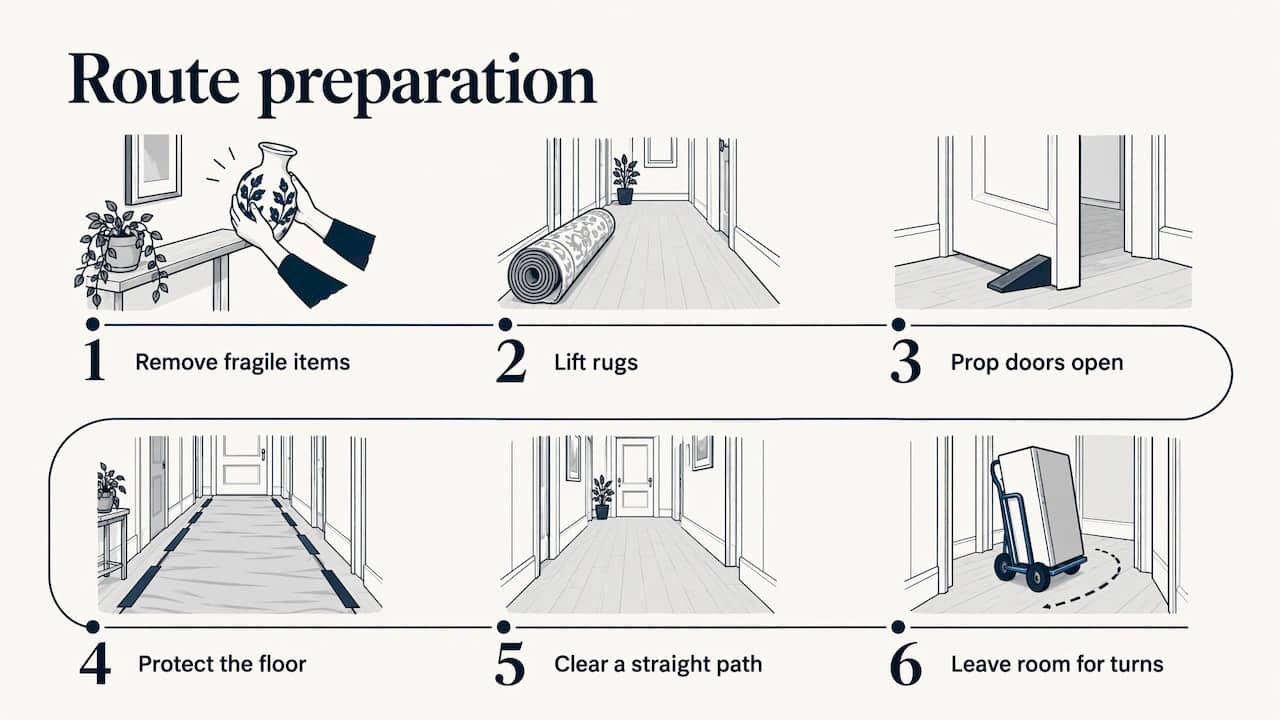
Plan the route in advance to avoid unexpected bumps and collisions, as This Old House puts it. Take down anything fragile, lift rugs, prop doors open and lay floor protection. Bosch’s advice is not to move the appliance in a zigzag fashion, so clear a straight, direct path and make sure each turn has room.
Moving a heavy washing machine
Washing machines are heavy partly because of the concrete or cast counterweights inside, and they are top-heavy once tilted. Here is how to handle one.
- Turn off the water supply and the power, then disconnect the inlet and drain hoses. Let any remaining water drain into a bowl or tray.
- Follow your manual for securing the drum. Many machines have transit bolts or brackets that stop the drum from knocking around. Check the manual for your model.
- Tape the door shut and wrap the cable and hoses so they cannot trail.
- Tip the machine gently onto a sack truck with a strap, secure it, and move it with one person steering and the other spotting.
- For short distances on a hard floor, a glider or sliding pad under each corner may be enough.
At the new home, check the manual again for levelling and reconnecting. If the plumbing needs altering, use a qualified plumber.
Moving a really heavy fridge or freezer
Fridges are the appliance people most often get wrong, because the compressor is sensitive to how the unit is carried.
The Bosch UK guidance sets out a clear sequence:
- Remove the contents, switch off and disconnect the appliance.
- Remove the drawers, or tape them so they cannot move.
- Clear the route.
- Secure the door with rope, then strap the fridge to a trolley with heavy-duty ropes.
- Keep it upright if possible.
If it has been laid on its side, Bosch says to leave it still and upright for at least 3 hours before switching it on. Other guidance is more cautious. One UK manufacturer’s FAQ says that if a fridge has been laid down for some time, you should wait at least 24 hours in the normal upright position before turning it on, and that if you must lay it down, it is better to keep it at an angle than flat on its back. If you are unsure, follow the instructions in your own appliance’s manual, and when in doubt, give it the longer wait.
Defrost ahead of time so you are not carrying melt water. Allow plenty of time, since a full freezer takes hours to defrost.
Setting it up in the new place
Bosch recommends installing a fridge freezer out of direct sunlight and away from heating elements. It specifies a 30mm clearance to electric or gas hobs and a 300mm clearance to oil or solid-fuel cookers. If the appliance is going to be switched off for a long period, leave the door open to prevent mould.
Cookers, ovens and anything gas-fired
Electric ovens and hobs are heavy but straightforward once they are isolated at the mains. Gas is a different matter.
The Gas Safe Register says you should never try to fix, fit or move appliances such as your boiler or cooker yourself. It warns that badly fitted or poorly maintained gas appliances can cause gas leaks, fires, explosions and carbon monoxide poisoning. It also states that, by law, anyone carrying out gas work as part of their business must be competent and registered, and that it is illegal for someone who is not Gas Safe registered to fit a gas appliance.
In practice, that means:
- Have a Gas Safe registered engineer disconnect your gas cooker and cap the supply before moving day.
- Have a registered engineer connect and test it at the new address before you use it.
- Remove loose shelves and trays from the oven, and tape the door shut, so nothing rattles or breaks in transit.
Whirlpool makes the same point from the manufacturer’s side: gas lines can be complicated to disconnect and reconnect, and a professional appliance technician is worth hiring.
You can check any engineer on the Gas Safe Register’s own site, and you should ask to see their ID card.
Stairs, tight turns and awkward spaces
Stairs turn a heavy appliance into the riskiest part of a move. A trolley stops being a help once you are on steps, and a heavy unit can slip very quickly.
- Use a stairclimbing trolley designed for the job, and only with the people it needs. Do not improvise with a standard sack truck.
- Keep the load on the downhill side of the person below, never above.
- Move one step at a time, with a clear signal between you.
- Stop and rest whenever your grip or footing is in doubt.
If a doorway is too narrow, do not force the appliance through. Check whether the door can come off its hinges, and whether the unit can be turned on its side as the manual allows. Sometimes the right answer is a different route, such as a patio door or a window with a proper hoist, which is a job for a professional crew.
Our view: why we treat appliances as specialist items
We have been handling people’s belongings across Chester, Wrexham and North Wales for over 20 years, and heavy appliances are where careful handling matters most. A fridge freezer or washing machine is expensive, and the damage often does not show until it is plugged in at the other end.
Our approach is to treat each item with care when we load it, while it travels and when we unload it. We look at the route, the stairs and the access before the day, so there is a plan and not a surprise on the doorstep. We plan for that as part of our large item removals, because a heavy item moved properly is less likely to hurt someone or damage a home.
We are fully insured, and we tailor each move to the customer, whether it is a flat with one washing machine or a family home with a full kitchen of appliances. If you are weighing up whether to do it yourself, our advice is simple: if the appliance is heavy, the access is awkward or you are tired, let a team do the lifting. It lets you focus on everything else about the move.
the author
When to call professional removers
Handling a washing machine on the flat with a helper and a trolley is realistic for many people. Hand it over when:
- The appliance is very heavy, such as an American-style fridge freezer, a range cooker or a large chest freezer.
- There are stairs, a tight landing or a narrow doorway.
- You do not have a second strong person, or the right trolley and straps.
- The appliance is gas-fired and needs disconnecting (you still need a Gas Safe engineer for that part).
- Your back, hands or health make lifting a risk.
Bosch’s own guidance is to contact a professional mover if you are unsure, and that is a good rule for any heavy appliance.
It also helps to bundle appliances into a larger plan. If you are moving house, a removals team can take white goods alongside furniture in one trip, and a packing service can wrap fragile items so you are not doing it the night before. If you have a tight deadline, our guide to organising a last minute move covers what to prioritise. If your new place is not ready, storage means appliances can wait safely until it is.
Move your appliances with Taylormade
We move homes and businesses across Chester, Wrexham, Cheshire and North Wales, including large items, pianos and heavy white goods. Our home removals service covers loading, transport and unloading, with packing and storage available if you need them.
If you are in Chester, see our Chester removals page. If you are in Wrexham, see our Wrexham removals page. Tell us what you are moving, where it is going and what the access looks like, and we will put together a tailored quote. If you are clearing a property rather than moving, our house clearance service can take unwanted appliances away responsibly.
A final checklist for moving day
- Measure the appliance and every doorway and turn on the route.
- Read the manual for transit and reconnection instructions.
- Empty, clean, dry and unplug it. Drain hoses and defrost freezers in advance.
- Secure doors, drawers and cables.
- Lay floor protection and clear the path.
- Gather the dolly, straps, blankets and gloves, and line up a helper.
- Strap the appliance to the trolley, and move it upright and in a straight line.
- Book a Gas Safe engineer for any gas appliance.
- At the new home, install with the correct clearances and wait before switching on a fridge or freezer.
FAQ
How can I move heavy appliances easily?
Use equipment instead of strength. An appliance trolley with a strap, sliders under the corners and a second person make the job far easier than lifting. Clear and measure the route first, and keep the appliance moving in a straight line rather than a zigzag.
What is the 50/50 rule for appliances?
There is no single 50/50 rule in the manufacturer guidance we have used. For fridges, the practical rule is to leave the appliance upright after moving it. Bosch says to wait at least 3 hours if it was laid on its side, and another manufacturer advises 24 hours if it was laid down for some time. Check your manual.
What can I use to move a heavy washing machine?
An appliance sack truck with a strap is the usual choice, with a helper to steer. Gliders or sliding pads help on short, flat runs. Disconnect and drain the hoses first, and secure the drum and door as your manual says.
How do I move a really heavy fridge?
Empty and defrost it, switch off and disconnect it, and tape or remove the drawers. Secure the door, strap it to a trolley with heavy-duty rope and keep it upright. Two people are the minimum, and a professional team is the safer option if stairs are involved.
Can I move a gas cooker myself?
No. The Gas Safe Register says you should never try to move a cooker or boiler yourself, and unregistered gas work is illegal. Book a Gas Safe registered engineer to disconnect and reconnect it, and leave the heavy carrying to a removals team.
Sources
- Moving a fridge freezer, Bosch UK
- Manual handling at work: Good handling technique, HSE
- How to Move Heavy Appliances, Whirlpool
- How To Safely and Efficiently Use a Moving Dolly, This Old House
- Tips for Moving Your Appliances, This Old House
- FAQs, Shoreline DC
- Home Improvements, Gas Safe Register


Leave a Reply
Want to join the discussion?Feel free to contribute!