


End of Tenancy Clearance: What It Involves and How to Do It Right
An end of tenancy clearance is the removal of everything a tenant has left in a property, from furniture and appliances to boxes and rubbish, so it is empty and ready for cleaning, repairs and the next let. Done well, it is quick, documented and legally safe for the landlord. We carry out end of tenancy clearances across Chester, Wrexham, Cheshire and North Wales, so tenants and landlords get a fully managed clearance instead of a weekend of skip runs.
TL;DR
- Clearance removes belongings and waste; cleaning comes afterwards. Book them in that order.
- A landlord should not simply bin a former tenant’s goods: the law expects notice and reasonable care first.
- Photograph and list everything left behind before anything moves.
- Anyone taking waste away must be a registered waste carrier, and you can check this online.
- Tenants avoid disputes by clearing fully, checking every cupboard and handing back keys on time.
Table of Contents
- What end of tenancy clearance actually involves
- Why the law makes this more than a tidy-up for landlords
- What to document before anything is moved
- What tenants should do before moving out
- Checks before you book a clearance
- How the timeline usually runs
- Why a managed clearance beats doing it yourself
- Booking an end of tenancy clearance with us
- FAQ
- Sources
What end of tenancy clearance actually involves
Clearance is the physical job of emptying a property. It covers furniture, white goods, bedding, clothes, boxes, garden items and general rubbish. It ends when the rooms, loft, shed and garden are empty and the property is broom-clean at most.
It is often confused with end of tenancy cleaning. Cleaning deals with surfaces: ovens, carpets, bathrooms, windows. It cannot start properly while a sofa, a pile of bin bags or a wardrobe is still in the way. So the sequence is always the same: clearance, then repairs, then cleaning, then marketing the property.
The people who need it fall into three groups:
- Tenants who are leaving with more than they can carry, or who are downsizing, relocating at short notice or sharing a house with people who have already gone.
- Landlords and letting agents whose tenant has moved out and left contents behind, and who need a void turned around quickly.
- Families and executors dealing with a rented home after a bereavement. We also offer bereavement house clearances for this.
What can be cleared
Most household contents can be taken: sofas, beds and mattresses, wardrobes, tables, carpets, white goods, electrical items, kitchenware, books and personal papers (kept separate if the owner needs them). Heavy pieces need a proper team. If you are curious how bulky items are shifted safely, our guides to moving heavy furniture and moving heavy appliances set out the approach.
Two things deserve attention before loading starts. First, anything that looks valuable or personal, such as documents, photographs, jewellery or electronics, should be set aside and recorded. Second, hazardous items such as paint, chemicals or gas cylinders need separate handling and should be pointed out to the clearance team in advance.
Why the law makes this more than a tidy-up for landlords
When a tenant leaves goods behind, they remain the tenant’s property. That surprises many landlords. Under the Torts (Interference with Goods) Act 1977, a landlord who has not been authorised to dispose of a former tenant’s possessions becomes an involuntary bailee and can serve a notice under Schedule 1 giving the former tenant a reasonable period to collect them.
The duties on an involuntary bailee are limited, but they exist. They extend to acting reasonably in respect of the goods and not selling, disposing of or letting someone else take them. If a landlord breaches those duties, for example by throwing belongings away, the tenant could potentially bring a claim in conversion. Landlords holding goods should also treat them with reasonable care and not deliberately or recklessly damage them.
This is the main reason a managed clearance beats a rushed one: the order of events matters as much as the lorry.
The notice a landlord should serve
In England, the advisable route is a written notice requiring the former tenant to collect the goods by a set date and stating the intention to sell or dispose of them if they do not. A professional guide on former-tenant belongings says the notice should give:
- the landlord’s name and address;
- particulars of the goods and where they are held;
- a statement that they are ready for delivery;
- the date on or after which the landlord proposes to sell them;
- any amount due in respect of the goods.
The same guide advises giving a reasonable opportunity to collect, and at least three months if the notice includes an amount payable. It can be served in writing by registered or recorded-delivery post, by hand or at the former tenant’s last known address, and attaching it visibly to the property is worth considering. The notice should say what has been left, where it is kept and what will happen if it is not collected.
Because a mistake here can lead to a claim, a landlord with valuable goods, a disputed deposit or a tenant who cannot be traced should take advice from a solicitor before disposing of anything. Once the legal position is settled, the clearance itself is our part of the job.
A different rule in Wales
If your property is in Wrexham or elsewhere in Wales, the position differs. A landlord must safeguard the occupier’s property for 4 weeks from the day the contract ended, with exceptions where the goods are perishable, where safeguarding would involve unreasonable expense or inconvenience, or where the value is less than the deductible expenses. Check which rules apply to your tenancy before booking a date.
This is where flexible storage helps. Holding a tenant’s goods safely while the notice period runs lets a landlord keep the property clear and re-let it, instead of leaving it blocked. Our storage solutions are designed for exactly these in-between periods.
What to document before anything is moved
The higher the value of the items left behind, the greater the responsibility on the landlord to keep them safe and recover a fair price. Porter Dodson recommends itemised logging with photographs, storing goods elsewhere if reasonable so the property can be re-let, and communicating with the owner to arrange collection.
In practice, a sound record has six parts:
- Date-stamped photographs of every room, cupboard, loft, shed and garden before anything is touched.
- An itemised list with a note against anything of apparent value.
- Copies of every message to the tenant, including the notice, the proof of posting and any reply.
- The tenancy end date and key return date, so the timeline is clear.
- The clearance invoice and disposal paperwork, showing what went where.
- A record of anything sold or donated, with the proceeds treated as the notice described.
Ask the clearance team for a written summary of what was removed and when. A tidy paper trail turns a possible dispute into a short email exchange.
What tenants should do before moving out
Most left-behind-goods disputes start with a rushed final day. A tenant who follows a simple routine protects the deposit and avoids removal charges.
- Take everything: possessions, rubbish, unwanted appliances, food and personal paperwork. A letting agent’s checklist notes that leaving unwanted items can lead to removal or disposal charges.
- Check every drawer, cupboard, loft and outbuilding, and clear gardens and back yards as well as rooms.
- Compare the property with the original inventory and take dated photographs. A moving-out guide also suggests recording final meter readings and giving a forwarding address when you return the keys.
- Hand in the keys by the stated deadline.
If the final week is already tight, a tenant can book us for the heavy lifting. Our guide to organising a last-minute move shows how short-notice jobs are planned, and our packing service takes the sorting and boxing off your hands.
Checks before you book a clearance
A clearance means handing waste to someone else, and the responsibility does not vanish when the van leaves. Householders have their own duty of care for household waste under section 34 of the Environmental Protection Act, and the government’s code of practice says that if a private business takes your waste, you should check that it is an authorised carrier with a valid registration.
The same code gives you the practical checks:
- Carriers hold a registration number starting CBDL or CBDU, followed by numbers.
- In England you can look a carrier up on the Environment Agency’s public register by registration number, business name or postcode, or by phoning 03708 506 506.
- In Wales, Natural Resources Wales runs the public register.
- Record the business details and the vehicle used, and ask for a copy of the carrier’s licence.
Beyond that, ask four plain questions of any provider: is the quote written and does it list what is included; is the work insured; where will the goods go; and will you receive paperwork afterwards? A fly-tipped sofa traced back to a landlord’s address is an expensive lesson, so these answers matter.
Reuse and recycling
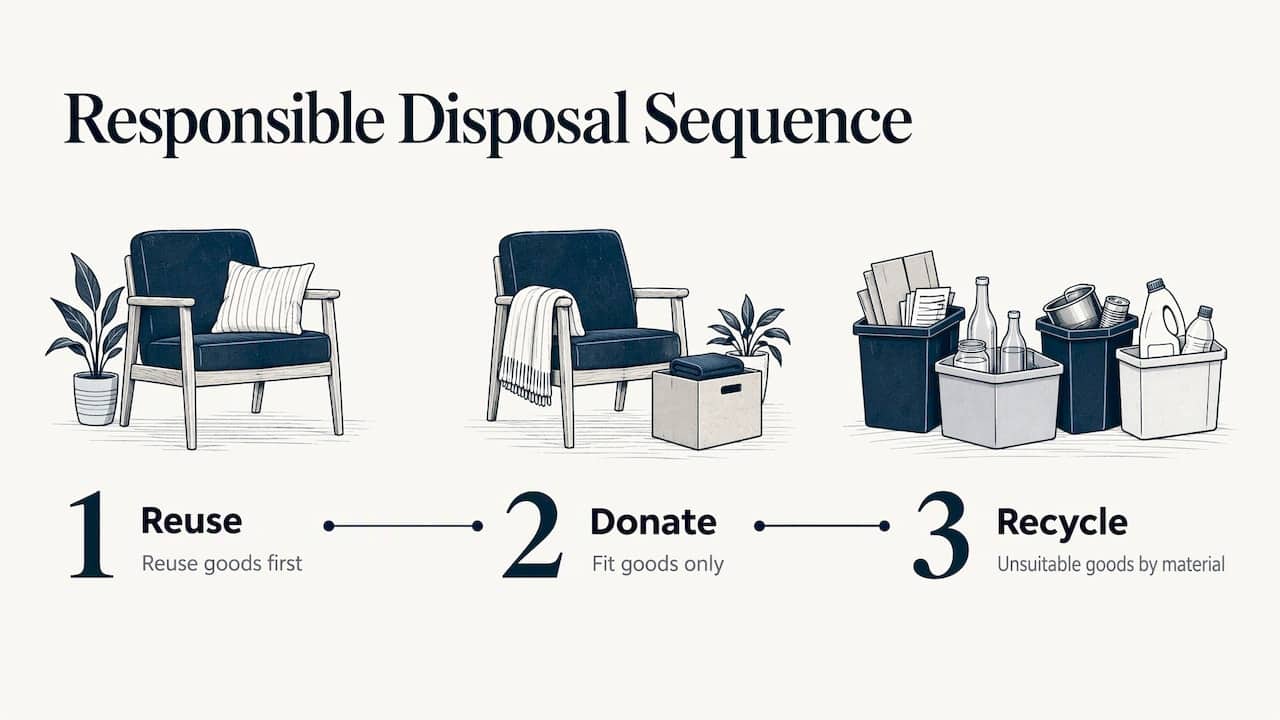
A good clearance does not send everything to landfill. The sensible order is reuse first, donate only goods fit for reuse, and recycle unsuitable goods through material-specific facilities rather than treating all contents as general waste. Local councils spell this out: Leeds City Council, for example, says furniture and electrical goods should generally be clean and usable, and that sofas, chairs and beds need fire-safety labels for reuse. Sorting the goods this way is part of responsible disposal, and it is part of how we approach clearances.
How the timeline usually runs
A typical landlord clearance follows this order:
| Stage | What happens | Who is involved |
|---|---|---|
| Tenancy ends | Keys returned, inspection, photographs and inventory of contents | Landlord or agent |
| Notice (where needed) | Written notice to the former tenant to collect goods by a set date | Landlord, with legal advice if values are high |
| Collection window | Tenant given reasonable time; goods held in place or in storage | Landlord, tenant |
| Clearance | Property emptied, items sorted for reuse, recycling or disposal | Clearance team |
| Cleaning and repairs | Deep clean, decoration, safety checks | Cleaners, contractors |
| Re-let | Property marketed and let | Landlord or agent |
The longest stage is the notice window, not the clearance. That is why landlords who plan the legal step early re-let sooner.
Why a managed clearance beats doing it yourself
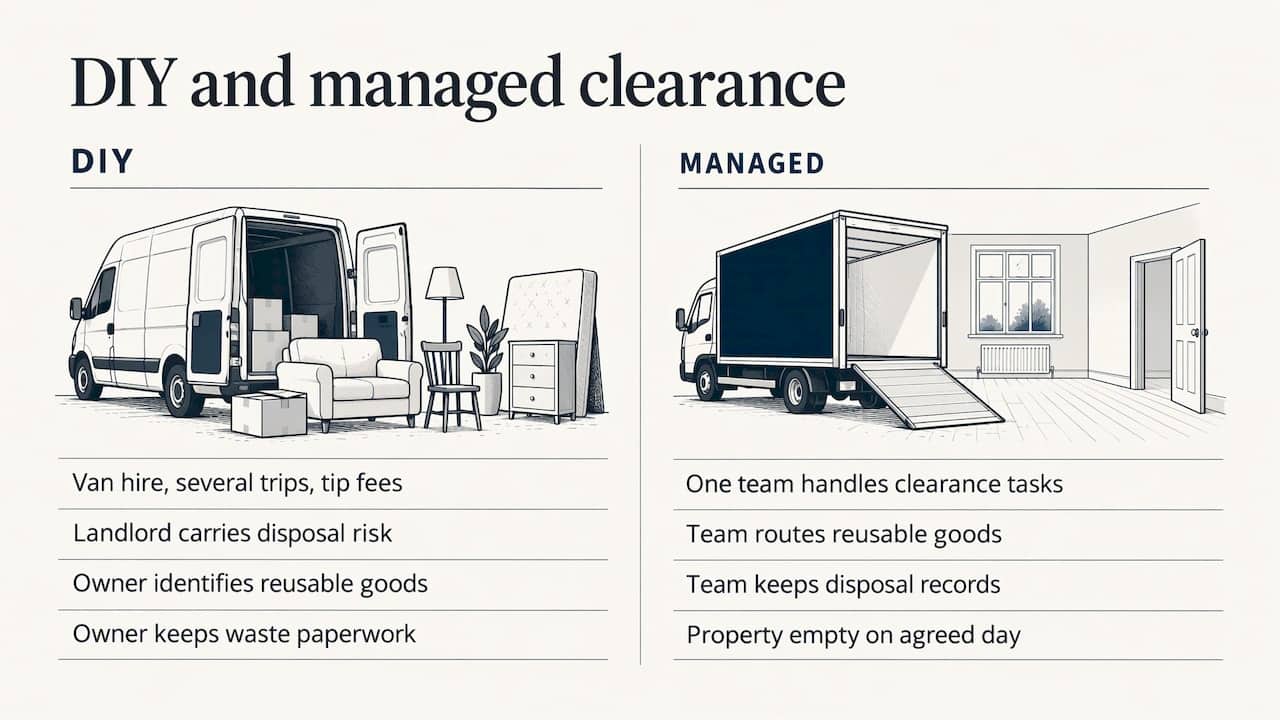
Doing it alone looks cheap on paper: hire a van, make several trips, pay at the tip. In practice it costs time at the one moment a void costs money, and it leaves the landlord holding the risk. Someone must lift the wardrobes, identify what is reusable, find the right disposal route, keep the paperwork and prove that the waste went to an authorised place.
A managed service puts those tasks with one team. For tenants, it means one call instead of a week of trips. For landlords and letting agents, it means a property that is empty on the agreed day, with a clear record of what happened.
Our view on end of tenancy clearance
After more than 20 years of removals in Chester, Wrexham and the surrounding areas, we see the same pattern: the stress of a tenancy ending comes from uncertainty, not from the boxes. Nobody is sure what the rules are, who is responsible for what, or how long it will take.
Our approach is to treat a clearance the way we treat a house move: with care, with a plan and with respect for belongings that may matter a great deal to someone. Every item is handled carefully during loading, transport and unloading, and we are fully insured.
We also think clearance and storage belong together. A landlord holding a former tenant’s goods, or a tenant between homes, should not have to choose between leaving things in the property and getting rid of them. Flexible storage gives that breathing space.
The result we aim for is simple: an empty, ready property, an honest account of where everything went, and one team to speak to throughout.
the author
Booking an end of tenancy clearance with us
We handle end of tenancy clearances for homeowners, tenants, landlords, letting agents and property owners in Chester, Wrexham, Cheshire and North Wales. The service sits alongside our wider house clearance work, including responsible disposal of unwanted items, and can be paired with packing, removals or storage if goods need to go somewhere else rather than to disposal.
Tell us the property type, the access, roughly how much is left and when you need it empty, and we will arrange a tailored quote. You can see the details on our house clearances page.

If you are also moving home, our home removals service can combine the move and the clear-out into one plan.
FAQ
Is end of tenancy clearance the same as end of tenancy cleaning?
No. Clearance removes the belongings and rubbish; cleaning deals with the surfaces and fittings afterwards. Clearance comes first, because a full property cannot be cleaned properly.
Can a landlord throw away what a tenant leaves behind?
Not straight away. A landlord holding a former tenant’s goods is expected to act reasonably, keep them with care and, in England, usually serve a written notice giving a reasonable period to collect them. In Wales a landlord must safeguard property for 4 weeks from the day the contract ended, with limited exceptions. For high-value goods or a dispute, take advice from a solicitor first.
Who pays for an end of tenancy clearance?
That depends on the tenancy agreement and the circumstances. A tenant who leaves items behind may face removal or disposal charges, and a landlord who clears goods the tenant is entitled to collect may be exposed to a claim. If you are unsure, ask your letting agent, or a solicitor if the amount is significant.
How do I check that a clearance company is allowed to take my waste?
Ask for its waste carrier registration number, which starts CBDL or CBDU. In England you can check it on the Environment Agency’s public register, and in Wales on the Natural Resources Wales register. Also record the vehicle used and keep a copy of the licence.
What happens to the items that are cleared?
Goods fit for reuse should be passed on where possible, and the rest should be recycled or disposed of through the right facilities rather than treated as general waste. We handle responsible disposal of unwanted items as part of our clearance service.
Sources
- Torts Act Notice Q&A: Guidance for Landlords, Porter Dodson
- Spring cleaning with the Torts (Interference with Goods) Act 1977, Wilsons Solicitors
- Back to basics: what to do about left-behind goods, Wedlake Bell
- My former tenant has left belongings at the premises, Chambers
- Does my landlord have to store my belongings? Citizens Advice
- End of tenancy checklist, Baskeys
- Ending a Tenancy: Notice Periods and Moving Out, SortedUK
- Get rid of unwanted items, Leeds City Council


Leave a Reply
Want to join the discussion?Feel free to contribute!