

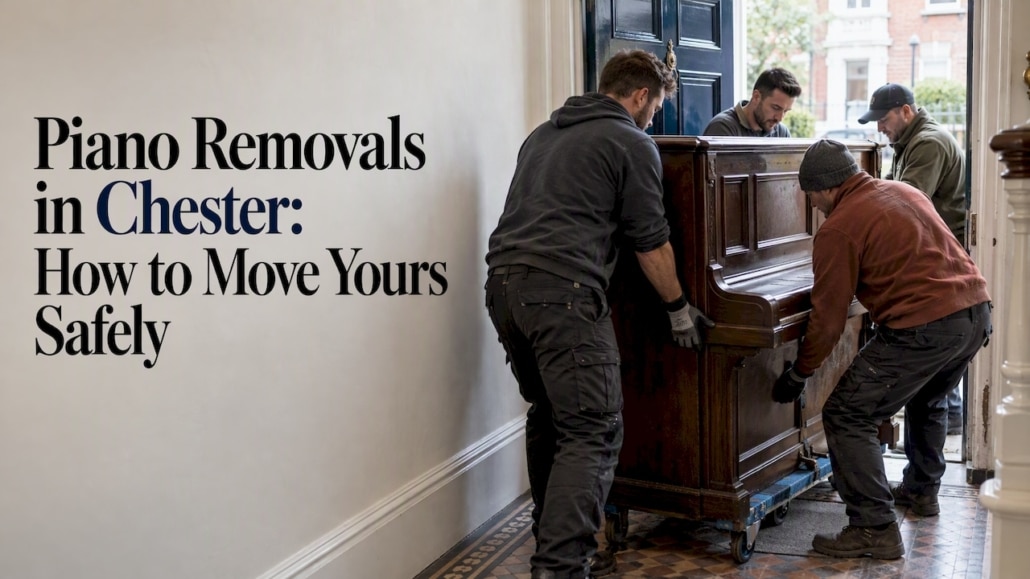
Piano Removals in Chester: How to Move Yours Safely
If you need a piano moved in or around Chester, hire a team that handles pianos regularly, send them photos and access details before they quote, and get the insurance cover for the instrument in writing. We move pianos as part of our home removals service, alongside packing and large-item moves. This guide explains what makes a piano different, what shapes the price, how to prepare, and what to ask before you book.
TL;DR
- A piano is heavy, awkwardly balanced and easy to damage. Uprights can tip, and grands must be lifted and supported correctly.
- Quotes depend on piano type, stairs, doorways, parking and distance. Photos and measurements get you a firmer figure.
- Local upright moves are often quoted at roughly £80 to £150 and grands at £150 to £500 or more, according to one UK price guide. Treat this as a guide only.
- Ask in writing whether the piano itself is insured in transit, and for what value.
- Allow time for the piano to settle after the move before it is tuned.
Table of Contents
- Why a piano needs specialist handling
- Upright, baby grand or grand: what changes
- Stairs, tight access and the people it takes
- What to tell a mover when you ask for a piano quote in Chester
- How much does piano removal cost?
- Insurance and written terms to check
- How to prepare your piano and your property
- Storing a piano during a move
- After the move: placement and tuning
- Our perspective
- Moving a piano with Taylormade
- FAQ
- Sources
Why a piano needs specialist handling
A piano concentrates a lot of weight in an awkward shape. The Pianoforte Tuners’ Association explains that uprights can tip because the heavy iron frame puts the centre of gravity towards the back, and that grand pianos must be lifted and supported properly. Incorrect handling can cause very serious damage.
Weight is the obvious problem. A UK music retailer notes that acoustic pianos commonly weigh well over 200 kg and that unsafe movement can lead to injury, damage to the case or internal damage that leaves the instrument out of tune.
The less obvious problem is the castors. Many people assume an upright can simply be wheeled across the room and out of the door. The Pianoforte Tuners’ Association says the small castors on many uprights are not designed for wheeling the instrument, and that it should be lifted and moved on a trolley. The same retailer adds that castors are meant mainly to support the piano and allow minor movements, not long-distance relocation, and that they can collapse under the load.
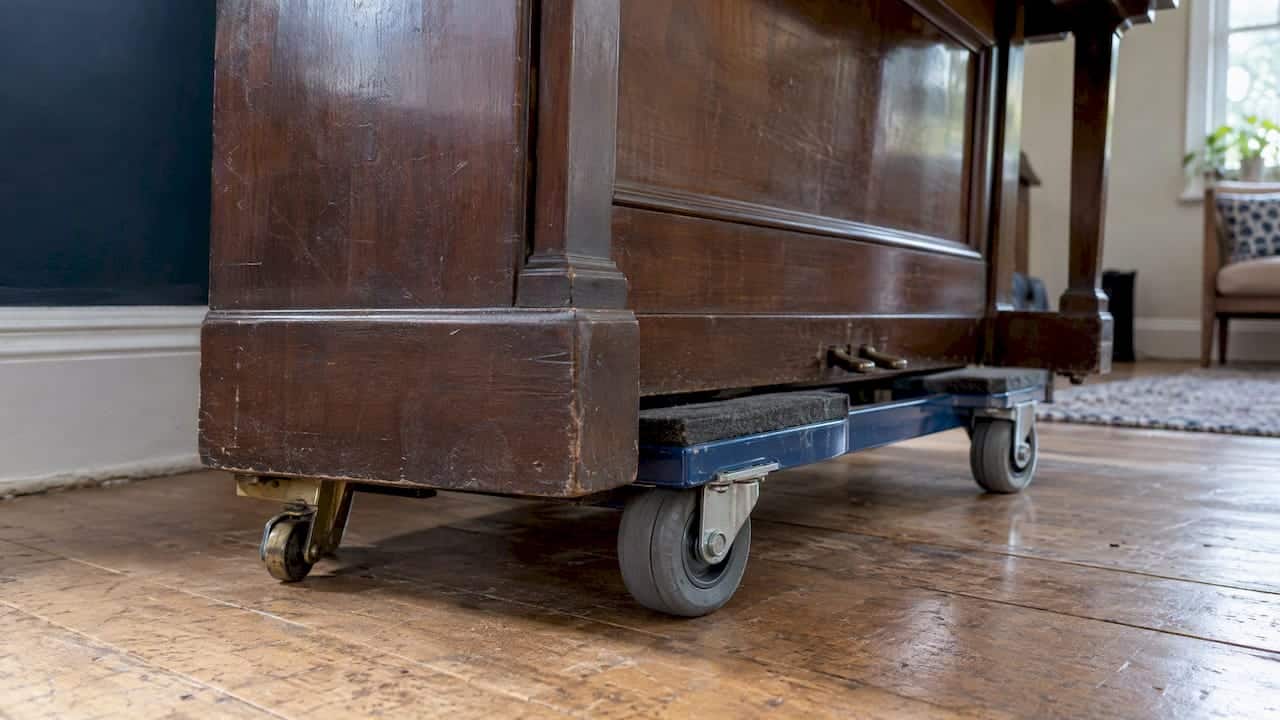
That is why a piano move is not a case of borrowing a few strong friends and a van. A mistake can hurt people, scar a hallway, and damage an instrument that may be worth far more than the cost of moving it.
Upright, baby grand or grand: what changes
The type of piano changes the crew, the kit and the method.
| Piano type | What the move involves | What to tell your mover |
|---|---|---|
| Upright or overstrung | Lifted onto a piano trolley or skid, strapped and padded. Tipping risk is the main concern. | Height, width, make if known, whether it has castors |
| Digital piano or keyboard | Much lighter, but cabinet models can still be bulky and fragile. | Model and whether the stand comes apart |
| Baby grand or grand | Normally partly dismantled: legs and pedal lyre removed, lid secured, then moved on a skid board. | Length, whether it is on the ground floor, how many stairs |
The general approach to grands is described in one UK price guide, which says a grand must be partly taken apart before it can be rolled safely on a skid board. It also needs more people and specialised equipment than an upright.
Stairs, tight access and the people it takes
Most piano problems show up at the doorstep, not on the road. Chester has plenty of period terraces, narrow hallways, tight turns on staircases and city-centre streets where a van cannot park outside. Each of these changes how the move is planned.
One UK retailer says that stairs, narrow corridors and obstacles are strong reasons to use an expert mover, and that even straightforward acoustic-piano moves generally need at least four people, depending on size and complexity.
The legal framework points the same way. HSE guidance says there are no specific weight limits for manual handling, but any assessment must consider the task, the load, the environment and the individual’s capability. It also says hazardous manual handling should be avoided where reasonably practicable and, where possible, mechanical help such as a trolley or hoist should be provided.
In practice, a good mover will ask about:
- the number of steps, and whether they are straight, curved or have a tight landing
- door widths and any awkward turns on the route
- where the van can park, and how far the carry is from the door to the van
- whether the destination is on a different floor, or has a step at the front door
A piano that will not pass through a doorway upright, or that needs to go up a spiral stair, is a job to flag at the quote stage, not on the day.
What to tell a mover when you ask for a piano quote in Chester
The more precise your details, the more accurate the quote. Have these ready:
- Type and size: upright, baby grand or grand, plus rough dimensions. A photo from the front and side helps.
- Collection address: floor, number of steps, doorway widths, parking.
- Delivery address: the same details. If you have not yet moved in, ask the vendor or agent for access information.
- Date flexibility: a flexible date can make scheduling easier, especially if the piano move is part of a wider house move.
- Value: a rough idea of what the piano is worth, for insurance purposes.
- Extras: whether you also need packing, a house move, storage or tuning arranged.
We do not publish piano prices, because the right figure depends on those details. If you are moving house at the same time, it often makes sense to ask for the piano and the rest of the move to be quoted together.
How much does piano removal cost?
There is no fixed rate, and anyone quoting a flat price without asking about access is guessing. One UK guide puts local upright moves at around £80 to £150, and grand or baby grand moves at £150 to £500 or more, depending on distance, access and the number of stairs. Treat that as a broad guide rather than a quote for Chester.
The main things that move the price:
- Piano type and weight. Grands need more people and kit than uprights.
- Stairs and access. Every flight, tight turn or long carry adds time and labour.
- Distance. A move across Chester costs less than one into North Wales or across the country.
- Parking. If the van cannot get close, the carry is longer.
- Whether the piano is part of a larger move. Combining jobs can be simpler to schedule than booking separately.
Be cautious about a price that is far below others. A very low figure may mean fewer people, no proper equipment or thin insurance. Ask what the price includes before you compare.
Insurance and written terms to check
This is the part many people skip. The same price guide points out that many removal firms carry goods-in-transit insurance, but per-item value limits may not cover a valuable piano, so a standard policy may pay out far less than the cost to repair or replace the instrument.
Before you book, get answers in writing to these questions:
- Is the piano itself covered while it is being loaded, carried, in the van and unloaded?
- What is the maximum value covered for a single item, and is that enough for your piano?
- What is the excess, and what is excluded?
- Does your home contents insurance cover the piano while it is being moved? Check with your insurer, as some policies treat items in transit differently.
- If the quote is by phone, can you have it confirmed by email, with the date, addresses, crew size and any extras?
We describe our services as fully insured. For a high-value or antique instrument, we would still ask you to tell us the value up front so that we can talk through cover with you before the day.
How to prepare your piano and your property
Good preparation makes the day faster and safer.
The piano
- Clear the top. Remove ornaments, photographs, plants and music books.
- Close and, if there is a lock, lock the lid. Do not tape anything to the wood or the finish.
- Do not try to wheel it yourself, for the reasons above.
- Photograph the piano from all sides before the move, so any later query is easy to settle.
- Note any existing marks, chips or loose parts and mention them to the crew.
The property
- Clear the route: shoes, rugs, furniture, pet gates, toys and bins.
- Measure the doors, hallways and stair turns at both addresses.
- Tell neighbours or arrange a parking space if the van needs one, especially on narrow Chester streets or in permit zones. Check with Cheshire West and Chester Council if you may need a suspension.
- Keep children and pets away from the working area.
- Protect floors if the crew asks, though we will normally bring covers.
If you are moving the whole household, our packing service can handle the boxes so that the crew can concentrate on the heavy items.
Storing a piano during a move
Sometimes the new home is not ready, you are renovating or you are downsizing into a space that will not fit the piano. Storage can work, but a piano is sensitive to its surroundings, so ask the right questions:
- Is the unit indoors, dry and free from damp?
- Is the temperature reasonably stable, or does it swing between hot and cold?
- Will the piano be raised off the floor and covered with a breathable cloth, not plastic sheeting?
- Can you access it, and how often?
- Is the stored piano insured, and for what value?
We offer flexible storage for people in transition, including renovations and downsizing. Tell us early if a piano will be part of what goes into storage, so we can plan the right space for it.
After the move: placement and tuning
A piano can shift slightly in tune after any move. The retailer mentioned above notes that unsafe moves can leave a piano out of tune, and a change of room, temperature and humidity can have an effect too. Place it on an internal wall away from radiators, direct sunlight, draughts and damp. Then book a tuner. The Pianoforte Tuners’ Association is the usual starting point for finding a qualified tuner in your area; many tuners recommend leaving the instrument to settle for a few weeks first, so ask yours.
Our perspective
Most piano damage happens in the few minutes when someone decides to “just manage” a tricky staircase. We would rather spend ten minutes on the phone beforehand than discover a narrow turn on the day.
Our approach is the same one we use for every household item: meticulous handling during loading, transport and unloading, with a team that treats your belongings as if they were their own. A piano simply asks for more planning, more people and more patience. We look at the access, agree the plan with you and keep you informed.
We have worked in Chester, Wrexham and the surrounding areas for over 20 years, and a piano is often just one part of a bigger move: the furniture, the boxes, perhaps a few weeks in storage while the new house is finished. Having one team handle all of it means fewer phone calls and fewer hand-offs, which is where things tend to go wrong.
the author
Moving a piano with Taylormade
We provide piano removals as part of our home removals service in Chester, Wrexham, Cheshire and North Wales. You can have the piano moved on its own, or as part of a full house move with packing and storage if you need it. Our team handles large items regularly, and we are fully insured.

To get a tailored quote, send us photos of the piano and a few details about both addresses through our Chester removals page. Prefer to see everything we do first? Our main site covers home, commercial and clearance services.
FAQ
Can I move a piano myself to save money?
It is risky. Pianos can weigh well over 200 kg, uprights can tip, and castors are not designed for wheeling the instrument any distance. Injury, damage to the piano and damage to your property are all real possibilities, so most people are better off hiring a team with the right equipment.
How long does a piano move take?
It depends on the piano and the access. One trade directory suggests that most piano removals take between one and three hours, but stairs, tight turns and long carries can lengthen that. Your mover should be able to give you an estimate once they know the layout.
Do I need a different team for a grand piano?
A grand usually needs more people and extra kit, as it is partly dismantled and carried on a skid board. Tell your mover whether you have a grand, a baby grand or an upright when you ask for a quote, so that the right crew and equipment arrive.
Will my usual removals insurance cover the piano?
Not necessarily. Per-item limits on standard goods-in-transit cover can be lower than the value of a good piano. Ask for the cover and the maximum item value in writing, and check your home contents policy as well.
Sources
- Pianoforte Tuners’ Association: Piano moving
- Millers Music: How to safely move a piano
- HSE: Manual handling at work
- Moving Compared: How much does piano removal cost?


Leave a Reply
Want to join the discussion?Feel free to contribute!