


Packing for a Move: What a Packing Service Includes
A professional packing service means trained packers come to your home with the right materials, wrap and box your belongings, and label everything so it can be loaded and unloaded in order. You can hand over the whole house, just the fragile rooms, or only the jobs you dread. At Taylormade Removals, we offer packing alongside our home removals in Cheshire and North Wales, and we price it after we know what you actually need packed.
This guide explains what is normally included, the difference between full and partial packing, what affects the cost, when to arrange it and how to compare quotes fairly.
TL;DR
- A packing service supplies materials, trained packers and labelling, so your belongings arrive protected and in the right rooms.
- You can choose full packing, partial packing (for example kitchen, glassware and pictures only) or pack everything yourself with materials supplied.
- Cost depends on the size of the home, how much you own, how fragile it is and how much you have already packed. Ask for a written quote after a survey.
- Book packing when you book the move, and tell your mover early if you will need last-minute help.
- Compare quotes on scope: what is packed, what materials are included, insurance cover and VAT.
Table of Contents
- What a packing service actually includes
- Full, partial or fragile-only: choosing the right level
- How a packing service works, step by step
- How to prepare before the packers arrive
- When to arrange packing help
- What affects the cost of a packing service
- How to compare packing quotes fairly
- Packing for special items
- Our perspective on packing
- Get packing help from Taylormade Removals
- FAQ
- Sources
What a packing service actually includes
The basics are simple. Packers bring materials, wrap and box your possessions, seal and label the boxes, and leave them ready for the removal crew. The British Association of Removers (BAR) says its members use a range of appropriate packing materials and employ fully trained staff who pack your things professionally and safely. Your remover can also supply all the packing materials you need if you would rather pack yourself.
In practice, a good packing service covers:
- Materials. Strong boxes in suitable sizes, packing paper, bubble wrap, tape, and specialist cartons for items such as wardrobes, pictures or glassware.
- Wrapping and boxing. Each item wrapped individually where needed, with heavier things in smaller boxes and lighter things in larger ones so nothing is overloaded.
- Labelling. Boxes marked with contents and destination room, so unloading is quick and you are not hunting for the kettle.
- Dismantling and protecting. Some packing jobs go hand in hand with taking beds or wardrobes apart. Confirm this is in your written scope rather than assuming it.
- Clearing up. Taking away used packaging where agreed, so you are not left with a mountain of paper.
Standards matter here as well. The BAR Code of Practice 2023, published by Trading Standards, says packing materials and method must be suitable for the purpose, that environmentally friendly disposable materials should be used wherever possible, and that quantities should be enough to protect goods in transit. The Approved Code Scheme adds that packaging must be of appropriate shape, size and strength and kept to that quality throughout its life.
Full, partial or fragile-only: choosing the right level
Most people do not need to choose between everything and nothing. Packing help usually comes in three levels.
| Option | What it means | Best for |
|---|---|---|
| Full packing | Packers box up the whole home, room by room | Busy families, long working hours, large homes, tight deadlines |
| Partial packing | Packers handle selected rooms or item types, you do the rest | People who want help with the hardest jobs only |
| Materials only | You pack; the mover supplies boxes, paper and tape | Organised movers with time to spare |
What partial packing usually covers
Partial packing means you decide which parts of the home the packers take on. Typical choices are the kitchen (crockery, glasses, small appliances), pictures and mirrors, ornaments and collections, the loft or garage, and the contents of display cabinets. Everything you are happy to pack yourself, such as clothes, books and bedding, stays on your list.
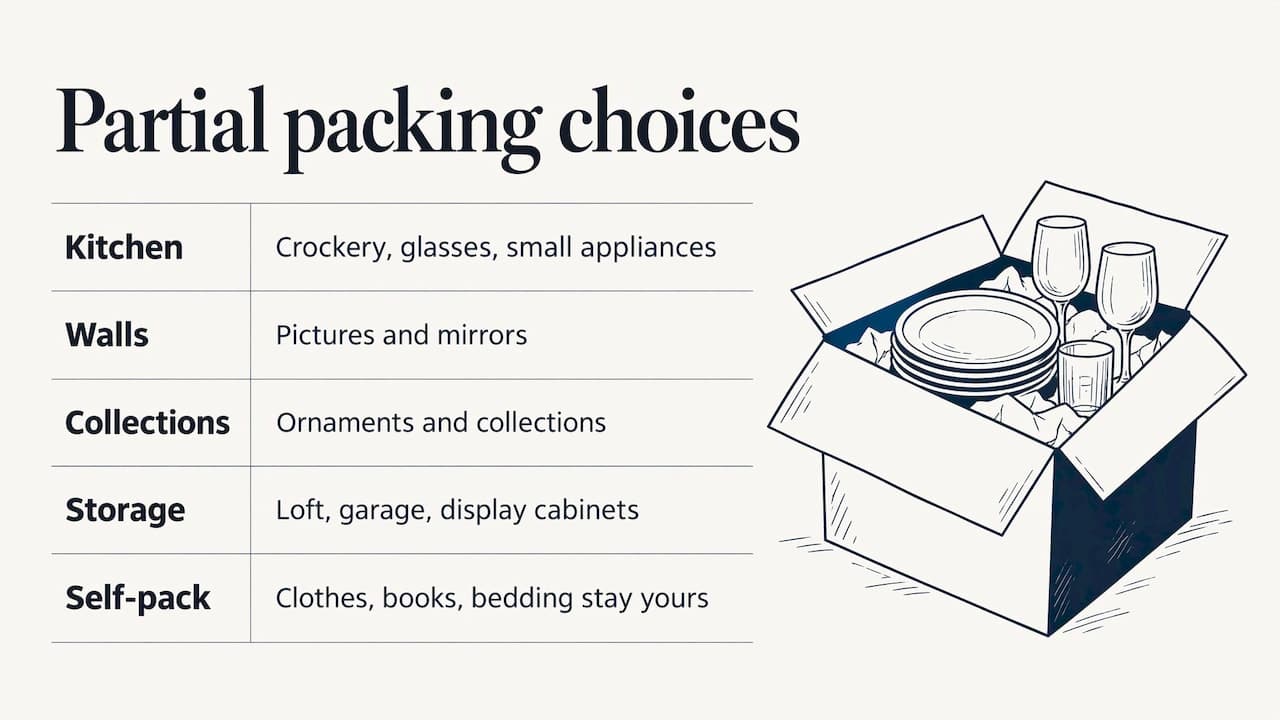
The sensible way to decide is to ask which items you would be most upset to see broken, and which jobs would take you longest. Hand those over. We are happy to agree a split like this at the survey and write it into the quote.
When full packing makes sense
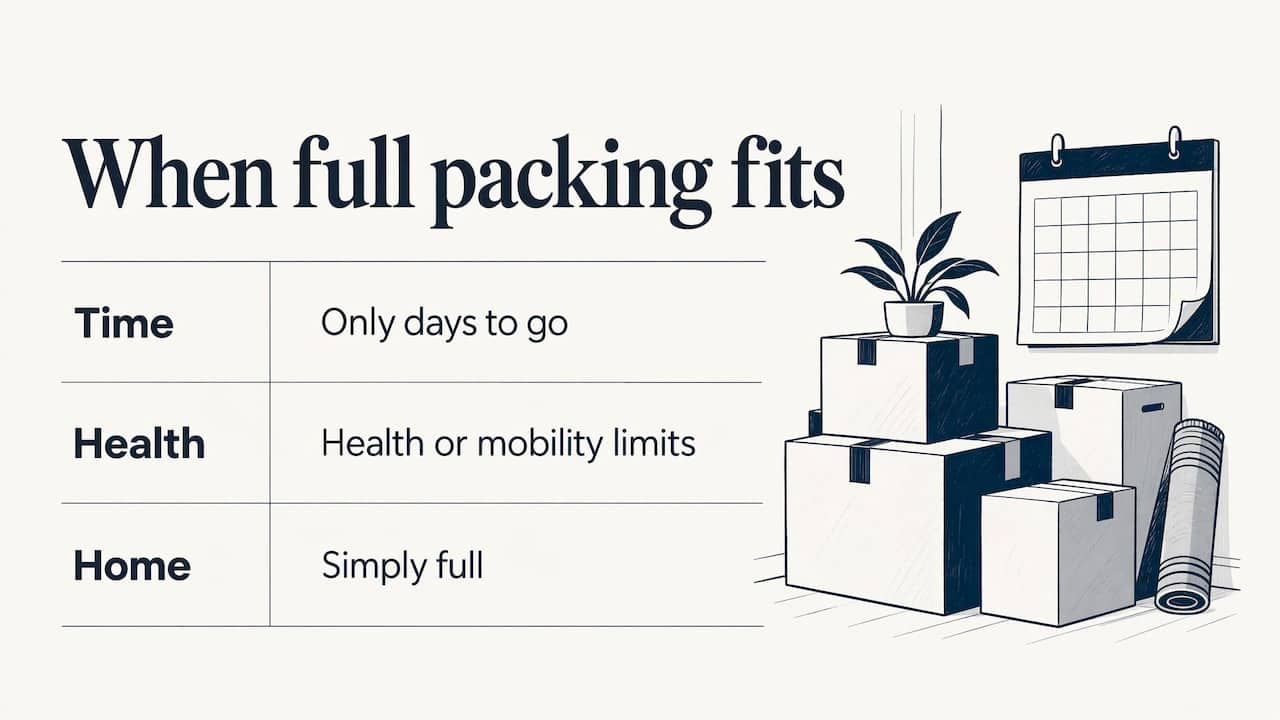
Full packing suits moves where time is short, where someone in the household has health or mobility limits, or where the home is simply full. It is also a good fit for a last-minute move, when there are only days to go and you cannot spend evenings wrapping plates.
How a packing service works, step by step
- Survey. An estimator visits, or surveys your home, to discuss the move. The BAR guide explains that the surveyor will explain the services and agree exactly what is included in the quotation and a detailed Service Specification.
- Written quote. It should state which rooms or items are packed, who supplies materials, and what happens to the packaging afterwards.
- Packing day. Often the day before the move, or the morning of it for smaller homes. Packers work room by room and label as they go.
- Loading and transport. Boxes are loaded in an order that protects fragile cartons and keeps room contents together.
- Delivery and unpacking. Boxes go to the labelled rooms. If unpacking is part of your agreement, packers can unwrap and place items where you want them.
How to prepare before the packers arrive
A little preparation makes the packers faster, which keeps the job smooth.
- Declutter first. Anything you will not keep should be sorted before packing starts. If a home needs more than a tidy-up, our house clearance service can deal with unwanted items responsibly.
- Set aside the essentials. Keep medication, documents, chargers, valuables and a first-night bag with you rather than in the van.
- Mark anything not going. Use a clear sign or keep those items in one room.
- Tell your mover what you have and have not packed. The British Association of Removers advises that if you pack yourself, you label each box with contents and destination room, protect fragile items with bubble wrap or paper, and warn your mover in advance if you will need last-minute packing help.
That last point matters. The BAR guide says if you have not finished packing you should give your mover reasonable warning, at least a phone call the day before, so they can bring the crew and materials, and an additional charge will apply. A phone call the day before is the minimum. Telling us when you book is far better.
When to arrange packing help
Book packing when you book the removal. Packers and vans are limited on busy dates, and the survey is much easier when you know which rooms you want covered. If your moving date is confirmed, you can usually add or change the packing level once you see how much you have packed yourself, as long as you tell your mover in good time.
A workable pattern for a self-packer who wants a safety net:
- A few weeks out: sort and declutter, pack out-of-season items and anything you rarely use.
- About a week out: review progress and decide whether to hand the kitchen, pictures or loft to professionals.
- The day before: pack the last essentials, set aside your first-night bag and make sure every box is labelled.
If plans change late, call us straight away. We can often adjust the crew and materials when we have notice.
What affects the cost of a packing service
Packing prices in the UK are not fixed. Several things move the figure:
- Size of the property. More rooms mean more packing hours and more materials.
- How much you own. A sparse three-bedroom house and a full one are very different jobs.
- Fragility and value. Glassware, artwork, collections and electronics take longer to wrap properly.
- Full versus partial. The less you ask packers to do, the lower the labour element.
- Materials. Boxes, paper, bubble wrap and tape are normally part of the quote unless you buy them separately.
- Access. Stairs, long carries and restricted parking all add time.
- Timing. Short notice and busy dates can limit what is available.
We do not publish a price list for packing because the right figure depends on your home. We give a written quote once we know the rooms, the contents and the access, so you can see exactly what you are paying for.
How to compare packing quotes fairly
Two quotes that look far apart often cover different work. One guide to removal costs suggests checking that each quote covers the same scope, including loading and unloading at both properties, dismantling and reassembling furniture, floor and door frame protection, goods-in-transit insurance and its cover limit, charges for stairs or long carries, and whether VAT is included. Always compare like for like.
A short checklist for any packing quote:
- Which rooms and items are packed, and which are left to you?
- Are boxes, paper, bubble wrap and tape included, and is any leftover material collected?
- Is unpacking included, or only packing?
- What insurance covers your goods, and up to what amount?
- Is the price inclusive of VAT?
- Is the company a member of a recognised trade body?
On that last point, the BAR Consumer Code of Practice was granted Approved Code status in 2008 and has been monitored and audited by the Chartered Trading Standards Institute since. BAR also says a detailed Service Specification helps avoid last-minute surprises by setting out what is and is not included, such as packing and special handling of large or fragile items. Ask any firm you are considering to put that in writing.
Packing for special items
Some belongings need more than a box and paper.
- Pianos. These are moved, not packed, and need trained handlers and the right equipment. See how we approach piano removals in Chester.
- Large and awkward items. Wardrobes, sofas and appliances need protection and often dismantling. Our large item removals are part of the same service.
- Items going into storage. Packing for storage should be done with how long they will stay in mind. If you need space for a renovation or downsizing, our storage solutions can be arranged alongside packing.
- Offices. Business moves need a plan for labelling by desk or department. Our business relocation service and commercial removals are project-managed to limit downtime.
Our perspective on packing
We have been moving people around Chester, Wrexham and North Wales for over 20 years, and packing is where a move is won or lost. Furniture is large and obvious. It is the box of glasses or the framed picture that decides whether you arrive feeling calm or stressed.
That is why we treat packing as part of the same careful handling you get on loading, transporting and unloading, not as an add-on. The people who pack are the people who know how the load will travel, and that shows in how things are wrapped and labelled.
We tailor the level of help to you. Some customers want the whole house done. Others want us to take the kitchen and the pictures and handle the rest themselves. Both are fine. We would rather agree a clear written scope at the survey than leave you guessing on the day.
Our services are fully insured, and we are proud of the testimonials from local customers who trusted us with their homes. If you want a packing plan that fits your timetable and budget, talk to us early.
the author
Get packing help from Taylormade Removals
If you are moving in Chester, Wrexham, Cheshire or North Wales, we can pack as much or as little as you like and move you in the same visit. Tell us the size of the home, the date and which rooms you want taken care of, and we will give you a clear, tailored quote. Start on our home removals and packing page, or see local details for Chester and Wrexham.

If you are clearing a property as well as moving, or need short or long-term storage, we can combine those with the removal so one team handles it all.
FAQ
How much does a packing service cost?
It depends on the size of the property, how much you own, how fragile it is and whether you want full or partial packing. We quote in writing after learning about your home, so the figure reflects the real job rather than a guess. Always check what materials and VAT are included when you compare.
What is the difference between full and partial packing?
Full packing means the packers box up everything in the home. Partial packing covers only the rooms or items you choose, such as the kitchen, glassware and pictures, while you pack the rest. Materials-only help is a third option if you want to pack yourself.
Can I pack some things myself and ask for help with the rest?
Yes. Tell your mover which rooms you will do and which you want covered. If you run out of time, give as much notice as you can: the BAR guide says to call at least the day before, and an extra charge applies for last-minute packing.
Does a removal company supply packing materials?
Yes, most professional movers supply boxes and wrapping, and BAR says your remover can provide all the materials you need at reasonable cost. Ask whether materials are included in the quote and whether leftovers will be collected.
Sources
- Your guide to a successful move, British Association of Removers (2024)
- The complete guide to moving home, British Association of Removers (2025)
- British Association of Removers, The Approved Code Scheme
- BAR Code of Practice 2023, Trading Standards
- Removal Costs 2026, Propelr


Leave a Reply
Want to join the discussion?Feel free to contribute!