

Garage Clearance Service: Costs, Checks and Preparation
A garage clearance service sends a team to empty your garage, sort what can be reused or recycled, and take the rest away legally. The price depends on how full the garage is, what is in it and how easy it is to reach. The one check worth making is whether the company is registered to carry other people’s waste. This guide covers what a clearance includes, what affects the cost, how to check a company and how to prepare, so you can book with confidence.
TL;DR
- A garage clearance covers emptying, sorting, loading and responsible disposal, and often includes a sweep-out at the end.
- Price is driven by volume, access, heavy or awkward items, and any waste that needs special handling. Ask for a written quote based on photos or a visit.
- In the UK, anyone who carries waste from other people’s property as part of their business must be registered as a waste carrier. Ask for the registration number and check it with the regulator for your nation.
- Sort what you want to keep, label it and clear a path before the team arrives. It saves time on the day.
- We help with house clearances across Chester, Wrexham, Cheshire and North Wales, and can talk through a garage as part of a wider clear-out.
Table of Contents
- What a garage clearance service actually does
- What affects the cost of garage clearance
- How to check a garage clearance company is legitimate
- What happens to the contents
- How to prepare for a garage clearance
- Our view on garage clearance
- Clearing a garage with Taylormade Removals
- Common mistakes to avoid
- FAQ
- Sources
What a garage clearance service actually does
The job sounds simple: take everything out and take it away. In practice a good clearance has four stages.
- Assessment. The company works out the volume, the access and the mix of items, either from photos or on a visit.
- Removal. The team carries everything out, including awkward or heavy things such as old workbenches, shelving, freezers, bikes and building offcuts.
- Sorting. Items are separated into what can be reused, what can be recycled and what must go for disposal.
- Disposal and tidy-up. Waste is taken to permitted sites, and the empty garage is swept so you can use it again.
People search for a garage clearance service for different reasons. Some are moving house and the garage is the last room left. Others are landlords between tenants, families sorting a property after a bereavement, or homeowners who want their parking space or workshop back after years of accumulation. Each situation changes what you need: a landlord needs a fast turnaround, a bereaved family needs patience and care with sentimental items, and a mover needs the date to line up with completion.
What a garage clearance usually includes
Most providers will take furniture, boxes, tools, bikes, garden equipment, general household items, old appliances and general rubbish. Many will also separate items that are still useful so they are not simply thrown away. What is included in a quote varies from company to company, so ask what the price covers: labour, loading, disposal fees and the final sweep.
Items that need special handling
Some garage contents cannot just go in the back of a van with everything else. Paint, solvents, oil, batteries, gas bottles, chemicals and asbestos-containing materials such as old cement sheet roofing are classed as hazardous or need special routes. Tell the company about them when you ask for a quote, not on the day. A reputable team will tell you how it will handle them and whether there is an extra charge. If you are not sure what a material is, say so and send a photo.
What affects the cost of garage clearance
No honest company can quote properly without knowing what is in the garage. The main factors are the same everywhere in the UK.
| Factor | Why it changes the price |
|---|---|
| Volume | A single garage with a few boxes is a very different job from a double garage stacked to the roof. |
| Access | Narrow drives, steps, no parking space for the vehicle or a long carry add labour time. |
| Heavy or bulky items | Workbenches, freezers, a piano, a hot tub or large machinery need more people and equipment. |
| Type of waste | Mixed general waste is simplest. Hazardous materials and some electrical items carry extra handling or disposal costs. |
| Sorting and reuse | Time spent separating items for reuse and recycling is part of doing the job properly. |
| Timing | Short-notice or fixed-time bookings can cost differently from flexible ones. |
We do not publish set prices for our services, because the honest answer depends on the job. If you want a figure from us, send photos or arrange a look at the garage and we will give you a tailored quote. Be wary of any price given over the phone with no idea of the volume, and of any quote that does not say what is included.
How to get a quote you can compare
When you collect quotes, give every company the same information so the figures mean the same thing:
- Photos from the door and from inside, showing the full depth of the garage.
- Whether it is a single or double garage, and whether there is a loft space or storage above.
- Any large, heavy or hazardous items.
- Where a vehicle can park and whether there are steps, gates or a narrow access.
- Your preferred date and whether you are flexible.
Then ask each company the same questions: is disposal included, is there a minimum charge, is the sweep-out included, and are they registered to carry waste?
How to check a garage clearance company is legitimate
This is the part many people skip, and it is the part that protects you. The law on waste carriers is set out by nation, but the principle is shared: if a business carries waste that other people produced, it needs to be registered.
Waste carrier registration in England, Wales and Scotland
In England the Environment Agency regulates waste carriers with two tiers. According to this UK guide to waste carrier licences, the lower tier is free and does not expire, and covers businesses that only carry waste they produced themselves. The upper tier carries a fee and renews every three years, and applies to everyone else who moves waste. Wales runs the same two-tier model through Natural Resources Wales.
Natural Resources Wales says upper tier registration is required if you transport waste created by someone else, and that it applies even when carrying waste is only an occasional part of the business. A company clearing your garage is carrying your waste, not its own, so the upper tier is the one that matters.
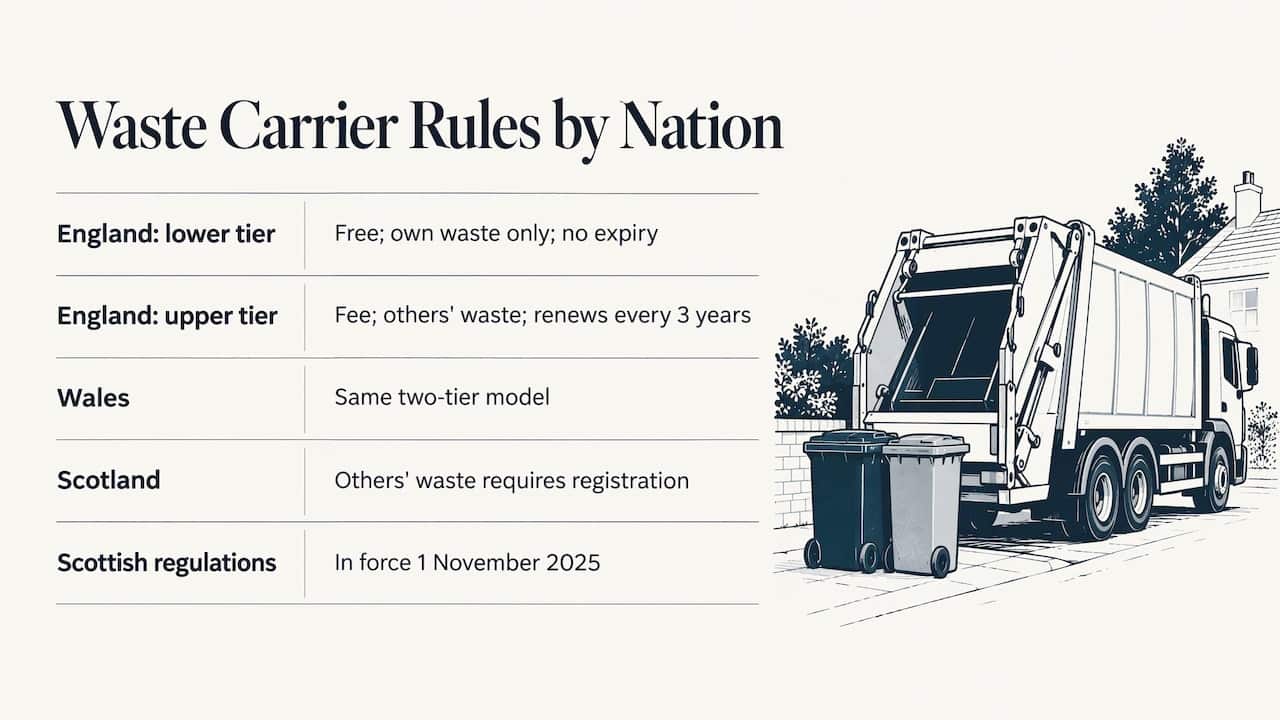
In Scotland, carrier registration sits under the Environmental Authorisations (Scotland) Regulations, in force from 1 November 2025, according to the same guide. The Scottish regulator, SEPA, states that if you transport other people’s waste in the course of business you must be registered, and that failing to register or to check that others are registered can lead to enforcement action, including a fixed monetary penalty.
What to ask before you book
- The registration number. A genuine company gives it without fuss. Check it on the register run by the regulator for your nation.
- The company name and address. They should match the registration and appear on your quote.
- Where the waste goes. Ask how items are sorted and which permitted sites receive the rest.
- Insurance. Ask whether the company is insured for the work, including damage to your property.
- Paperwork. Ask what you will receive afterwards.
Your own duty of care
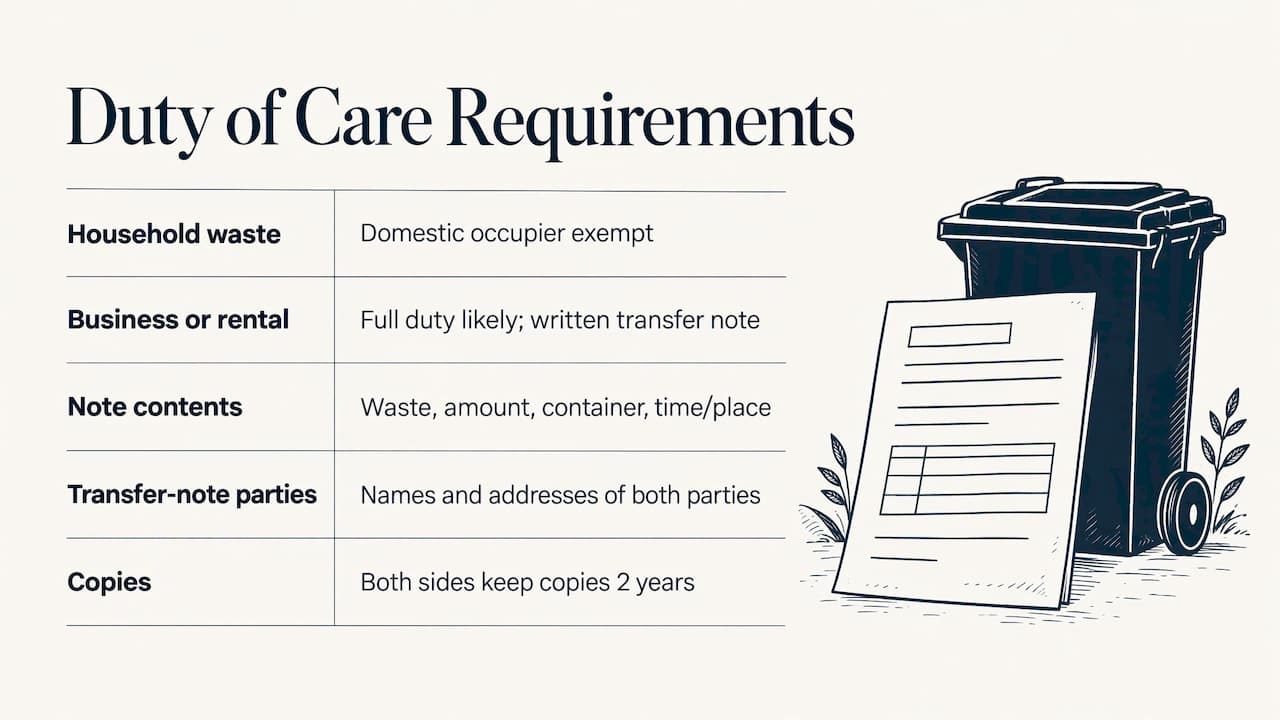
The law treats household waste differently from business waste. The Environmental Protection (Duty of Care) Regulations 1991 say the regulations do not apply to the occupier of a domestic property for household waste produced there. But the duty of care in section 34 of the Environmental Protection Act 1990 applies to anyone who produces, carries, keeps, treats or disposes of controlled waste. For a landlord, a business owner or a commercial garage, the full duty of care is therefore likely to apply, which means a written transfer note.
The same regulations set out what a transfer note must contain: it identifies the waste, the quantity, the container type, the time and place of transfer, and the names and addresses of both parties. Both sides must keep copies for two years. If you are clearing a business or rental garage, ask for this paperwork and file it.
SEPA also points out that registration shows customers a carrier is moving and disposing of waste responsibly and helps stop waste criminals undercutting legitimate businesses. A suspiciously low price for a full garage is a reason to ask more questions, not fewer.
What happens to the contents
The UK waste hierarchy puts waste prevention first, then preparing for re-use, then recycling, then other recovery such as energy recovery, with disposal last. It is set out in law through the Waste (England and Wales) Regulations 2011, as described in the Government Review of Waste Policy in England.
For a garage this works out simply:
- Reuse first. Furniture, tools, bikes and sports gear in decent condition can often go to someone who will use them.
- Recycle next. Metal, wood, cardboard, plastics and many electrical items have recycling routes.
- Dispose last. Only what cannot be reused or recycled should go for disposal.
Ask any company how it sorts. A team that can describe its routes in plain words is usually one that does the job carefully.
How to prepare for a garage clearance
A little preparation makes the clearance quicker and often keeps the job smaller.
- Decide what stays. Walk through and mark what you want to keep. Move these items to one corner, or out of the garage altogether, before the team arrives.
- Check the valuable and sentimental things. Old toolboxes, boxes marked with a name, photo albums and paperwork are easily lost in a clear-out. Look through them first.
- Remove personal and private items. Documents with your details should be dealt with before the day.
- Flag hazardous items. Paint, oil, gas bottles, chemicals and any suspected asbestos should be pointed out in advance.
- Clear a route. Make sure the team can get from the garage to the vehicle without obstruction, and tell them about parking restrictions.
- Think about what happens next. If the garage will be used for storage again, consider what you actually need to keep.
If you are moving house
The garage is often the part people leave until last. If you are moving, plan the garage with the rest of the move: decide what goes to the new home, what goes into storage and what goes for clearance. Combining these into one booking can simplify the day. We offer home removals across Cheshire and North Wales and secure storage for items you want to keep but do not have room for yet.
If you are a landlord or letting agent
Between tenancies, a garage can contain a surprising amount left behind. Photograph the contents before anything is removed, confirm in writing what you are entitled to clear, and keep the paperwork from the clearance company. Our end of tenancy clearances are designed for exactly this kind of turnaround.
Our view on garage clearance
We see garages at their worst moments: the last room of a house sale, the space nobody has opened since a bereavement, or the workshop a landlord has just got back. In every case the garage is the part people dread most, and the clearance goes best when it is treated like the rest of the move, with care.
Our approach comes from over 20 years of handling people’s belongings in Chester, Wrexham and the surrounding areas. We treat each item with care during loading, transporting and unloading, and that does not change because an item is sitting in a garage rather than a living room. Boxes of family photographs turn up in garages more often than people expect.
We are fully insured and we work with homeowners, tenants, businesses and landlords. We would rather talk through the job first and give you a tailored quote than hand you a number that ignores what is actually in the garage. Where items are worth keeping, we can help you move them or put them into storage rather than lose them.
the author
Clearing a garage with Taylormade Removals
We are a local removals company covering Chester, Wrexham, Cheshire and North Wales, and our house clearance service is fully managed, including bereavement clearances and end of tenancy clearances. If your garage is part of a wider clear-out, or you are moving and want the whole job handled by one team, get in touch and tell us what you have. We can also help with large items, packing and storage alongside the clearance.

Send us photos of the garage and a rough idea of your timing, and we will come back with a tailored quote. You can start from our house clearances page.
Common mistakes to avoid
- Accepting a price without seeing the garage. The quote should reflect real volume and access.
- Not asking for a registration number. It takes a minute and tells you whether the company is allowed to carry your waste.
- Leaving hazardous items as a surprise. Paint, oil, gas and asbestos-containing sheets change how a job is handled.
- Clearing before sorting. Valuable and sentimental items are the ones most often thrown away by mistake.
- Forgetting access. A blocked drive or no parking space can add time to the job.
- Skipping the paperwork on business or rental properties. Keep the transfer note for two years.
FAQ
How much does garage clearance cost?
It depends on volume, access, heavy items and the type of waste. A garage with a few boxes costs less to clear than a double garage packed to the roof. We give tailored quotes after seeing photos or the garage itself, rather than a one-size price.
Does a garage clearance company need a licence?
In England and Wales, a business that carries other people’s waste needs upper tier waste carrier registration, and in Scotland it needs a registration under the EASR rules. It is a registration rather than a licence in the usual sense, and you can ask the company for its number and check it with the regulator for your nation.
Do I need to be there on the day?
It helps, especially if there are items to keep or decisions to make. If you cannot be there, agree in advance what is to be cleared and what is to stay, ideally by marking or moving those items beforehand, and make sure the team can get in.
What happens to items that can still be used?
Under the waste hierarchy, reuse and recycling come before disposal. Ask the company how it sorts, so that usable furniture, tools and recyclable materials are not simply sent for disposal.
Sources
- Waste Carrier Licence: The Complete UK Guide
- Natural Resources Wales: deciding if you are a waste carrier, broker or dealer
- SEPA: waste carriers, brokers and professional collectors and transporters of waste
- The Environmental Protection (Duty of Care) Regulations 1991
- Government Review of Waste Policy in England 2011


Leave a Reply
Want to join the discussion?Feel free to contribute!