


Business Relocation Service: How to Move Your Company Smoothly
A business relocation service takes on the practical work of moving a company: surveying the site, planning the schedule, packing, moving furniture, equipment and files, and setting everything up at the new premises. The best results come when you bring the mover in early, agree a written scope, and plan IT and communications as carefully as the lorries. This guide shows how to plan a commercial move, what to check, and where a local specialist fits in.
TL;DR
- A commercial relocation service covers the physical move (survey, packing, transport, unloading, set-up). Your own team still owns the plan, budget and communications.
- Involve your removal contractor before dates are fixed. Early input gives you a feasibility check and a realistic costing.
- Write a Scope of Works first: what moves, what goes into storage, and what is disposed of or recycled.
- Start IT and connectivity planning months ahead, because internet lines can take a long time to install.
- Check insurance, accreditation and storage terms before you sign, not after the van arrives.
Table of Contents
- What a business relocation service actually does
- Start with a plan, and bring your mover in early
- Write a Scope of Works before you request quotes
- Treat IT and connectivity as the critical path
- Before, during and after: a practical checklist
- Relocating a small business: what to weigh up
- Where storage helps during a business move
- Insurance, standards and what to ask any provider
- Moving with Taylormade Removals
- FAQ
- Sources
What a business relocation service actually does
The phrase covers two quite different jobs, and it helps to know which one you need.
Corporate relocation management usually means moving employees: housing searches, visas, family support. If you are bringing staff across the country or from abroad, that is a specialist field of its own.
Commercial removals is the physical side: moving desks, computers, archives, workshop kit, stock and fittings from one building to another. This is what most owners of small and medium firms mean when they search for a business relocation company, and it is what we do at Taylormade Removals across Chester, Wrexham, Cheshire and North Wales.
A commercial removal provider will typically handle some or all of the following:
- A site survey and written quotation before anything moves.
- Planning the sequence of the move, including who leaves first and who is set up first.
- Packing of desks, files, equipment and fragile items, with labelling tied to a floor plan.
- Loading, transport and unloading, placing furniture where your plan says it should go.
- Moving large or awkward items, such as heavy machinery, safes or a piano in a reception area.
- Short or long-term storage for items that are not going straight into the new space.
- Disposal or recycling of furniture and equipment you no longer need.
What a mover will not do for you is decide your strategy: whether to move, where, and when. That sits with you, though a good provider will give practical input.
Start with a plan, and bring your mover in early
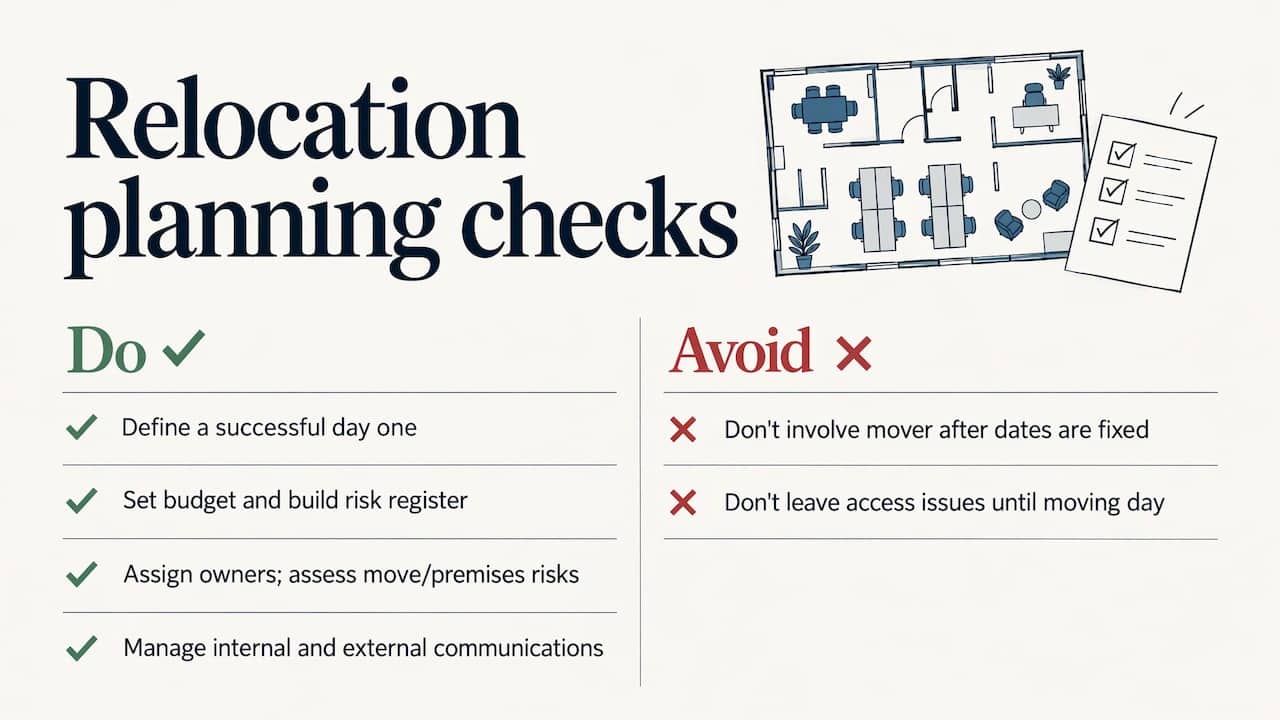
Planning is what separates a quiet Monday morning in the new office from a week of lost trading. Industry good-practice guidance for office moves states that the contractor should join the project plan at an early stage, supplying a feasibility study and detailed costing rather than being called in once dates are fixed and the new building is already fitted out.
The reason is simple. A mover who sees the floor plan, lift sizes, parking restrictions and access hours can tell you early that a Friday evening move is unrealistic, or that a staircase will need extra hands. Those details change cost and timing, and they are cheap to fix on paper and expensive to fix on the day.
The employment law and HR advisers at Croner set out 16 steps for managing an office move. Among them are clarifying what a successful day one looks like, preparing an accurate budget, building a risk register, listing every task with a named owner, completing final risk assessments for the move and for operating in the new premises, and managing internal and external communications. You do not have to follow all sixteen to the letter, but the list is a useful audit of whether you have missed something.
A sample timeline
The timings below are a practical guide for a small or medium office. Treat them as a starting point and adjust for your size and sector. The IT milestones follow the lead times recommended by an IT services provider.
| When | What to do |
|---|---|
| 4 to 6 months out | Confirm the decision to move, set a budget, review your lease obligations, shortlist removal providers and ask for surveys |
| 12 to 16 weeks out | Complete an IT asset audit, an internet line survey and a site survey; write the Scope of Works; confirm the mover |
| 8 to 12 weeks out | Agree the floor plan, move schedule and storage needs; start informing clients, suppliers and staff |
| 4 to 8 weeks out | Install and test structured cabling and connectivity; arrange insurance updates; order new signage and stationery |
| 1 to 4 weeks out | Run full systems tests, take verified backups, begin packing non-essential items, label everything against the floor plan |
| Move day | Supervise access, check the inventory off, keep a point of contact on both sites |
| After the move | Walk-through audit, log any damage, gather staff feedback, hand back the old premises |
Write a Scope of Works before you request quotes
Before you approach any removal provider, be certain what the job is. Professional guidance recommends deciding what is not to be moved, what might need offsite storage, and what is to be disposed of or recycled, and recording all of it formally in a Scope of Works.
In practice, walk each room with a clipboard and sort every item into one of four groups:
- Moves to the new premises and goes to a specific place on the floor plan.
- Goes into storage because the new space is smaller, or because it is not needed yet.
- Is disposed of or recycled: broken chairs, obsolete equipment, old paperwork that has passed its retention period.
- Is sold or donated, if it still has value.
This single document makes quotes comparable, because every provider is pricing the same job. It also cuts cost, since you are not paying to transport items you will throw away on arrival.
Treat IT and connectivity as the critical path
Furniture is rarely what delays a business move. Connectivity is. One IT provider notes that lead times for leased lines can exceed 90 working days, which is why the audit and survey work belongs at the 12 to 16 week mark, not the week before.
A sensible IT checklist includes:
- An asset audit of every computer, printer, phone, screen and piece of network kit, with serial numbers.
- A survey of the new site’s internet options and cabling.
- Structured cabling installed and tested weeks before you arrive.
- Verified backups taken shortly before the move, and a full systems test.
- A plan for who unplugs, packs, and reconnects each workstation, and how phone numbers will carry across.
Tell your removal team which equipment is sensitive. Servers, specialist machines and anything under warranty need a different packing method and a defined order of arrival.
Before, during and after: a practical checklist
The UK materials-handling firm BIL Group sets out a simple structure in its office move guide. Here is how it translates into actions.
Before the move
- Map both premises, including where each team and each piece of equipment will sit.
- Coordinate utilities and services: electricity, water, broadband, phones, waste collection, post redirection.
- Declutter ruthlessly. Every box you do not move is money saved.
- Set a budget and complete the risk assessment.
On move day
- Supervise the move, with one named person on each site holding the floor plan.
- Manage access: building managers, parking, lift bookings and security passes.
- Make sure your insurance is updated for the new location.
After the move
- Walk through the new premises and log any damage straight away, with photos.
- Confirm furniture is where the plan said it should be.
- Gather staff feedback and resolve teething problems quickly.
- Decommission the old site: remove signage and fixtures, restore walls and carpets, and meet your lease obligations so that you get no unexpected dilapidations bill.
Relocating a small business: what to weigh up
Small firms feel the cost of a move more sharply, because there is no facilities team and no spare capacity. A few points are worth settling early.
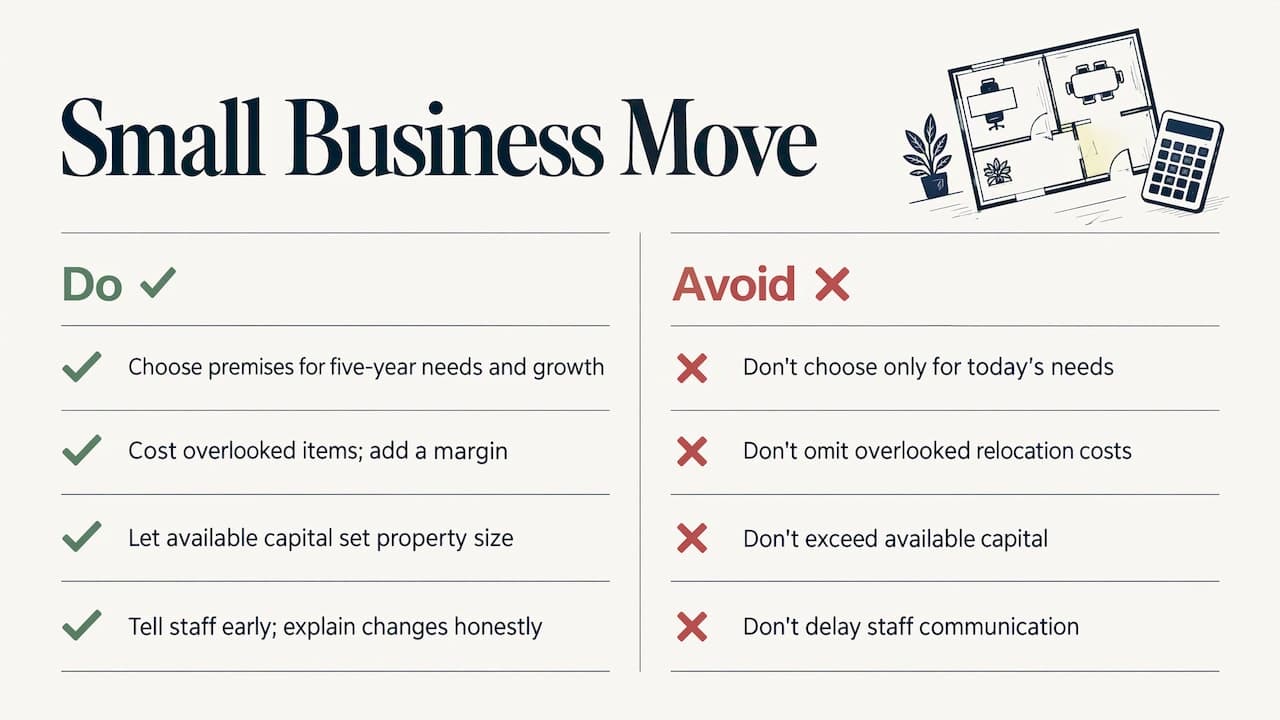
Choose for the next five years, not today. One business adviser recommends picking premises that meet current needs and leave room for growth, and checking transport links and the local job market, since these affect whether your staff can and will make the journey.
Cost everything. The same source lists items that are easy to overlook: solicitors’ and designers’ fees, lost trading time, building work, telephone and network access, security, furniture, stationery, vehicles and website updates. Add a margin for the unexpected.
Let capital set the limits. A business news publication points out that available capital drives the decision and has the biggest influence on the size of the property you can take. It also suggests using a local relocation agency to help organise the move and offer guidance on elements such as business rates and rent.
Look after your people. A move changes commutes, and that makes staff anxious. Tell them early, explain the reasons, and be honest about what changes. If a move alters roles or locations significantly, take advice on your redundancy and consultation obligations.
If you are in Cheshire or North Wales, our pages on office removals in Chester and office removals in Wrexham describe how we approach local company moves.
Where storage helps during a business move
Storage is often the piece that makes a relocation workable. It earns its place in situations like these:
- The new premises are not ready. Fit-out overruns are common, and storage bridges the gap between leaving the old building and entering the new one.
- The new space is smaller. Archives, spare furniture and seasonal stock can be held offsite rather than crammed in.
- You are moving in phases. Teams can move on different days while shared items wait safely.
- You are renovating or downsizing. Equipment can be held until it is needed again.
Before you commit to any storage arrangement, ask these questions:
- How is the space secured, and who can access it?
- Can you retrieve items on request, and with how much notice?
- What are the notice period and minimum term?
- How is the cover arranged while goods are in storage? Cover that applies during transport may not automatically continue once goods are inside a unit, so confirm it in writing.
- Is the storage suitable for paperwork and electronics, if that is what you are holding?
We offer flexible storage solutions for residential and commercial customers, which can be arranged alongside a move so that one team handles collection, storage and delivery.
Perspective
In our experience, the offices that move best are the ones that decide early what is really going with them. Most of the stress we see comes from late decisions: a surplus filing cabinet nobody wants, a storeroom nobody has sorted, a lift nobody has booked.
That is why we like to talk before dates are fixed. With more than 20 years of experience moving homes and businesses in Chester, Wrexham and the surrounding areas, we treat a company move as a project, with a plan, a point of contact and careful handling of every item through loading, transport and unloading.
Our approach is built on being a local, reliable team that offers a personal service. We can combine commercial removals, packing, storage and responsible disposal of unwanted items, so you are not coordinating several suppliers while also running a business.
the author
Insurance, standards and what to ask any provider
A commercial move puts valuable equipment on the road and into other people’s hands, so the paperwork matters as much as the van.
Insurance. Ask for evidence of cover, and ask what it includes. The sums involved vary by contract: one public-sector tender notice, for example, asked bidders to confirm at least £5m of Employer’s Liability, Public Liability, Professional Indemnity and Product Liability cover, alongside membership of the British Association of Removers. Your needs will differ, but the point is to match cover to the value of what is moving. Taylormade Removals states that its services are fully insured.
Your own insurance. Tell your business insurer about the move, as your existing policy may need updating for the new address and for the day of the move itself.
Standards. BS 8522 is the British Standard for commercial moving. It was published in full in 2009 to set a minimum level of service and performance for organisations moving office or business equipment, furniture and goods for commercial clients. It covers three phases: pre-move (contact, survey and quotation), the move itself, and post-move follow-up. Larger public and private tenders often ask for it, so if your own procurement rules require it, say so at the quotation stage.
The paper trail. Whoever you choose, keep the quote, the accepted terms, the inventory and your move-day notes together. If something is damaged, a clear record makes the conversation quicker and easier for everyone.
A short list of questions to ask every provider:
- Will you survey the site in person before quoting?
- Is the quote itemised against a written Scope of Works?
- Who will be my single point of contact on the day?
- What insurance is in place, and for what values?
- Can you handle packing, storage and disposal as part of the same job?
- How do you handle out-of-hours or weekend moves, so we lose minimal trading time?
Moving with Taylormade Removals
We are a Chester-based removals team serving Chester, Wrexham, Cheshire and North Wales. For businesses, we provide commercial removals and fully managed office removals, along with packing, large-item handling, storage and responsible disposal of items you no longer need.
If you are planning a move, tell us your size, your current and new addresses, and your preferred timing, and we will talk through a plan with you. See our commercial removals service for the details, or get in touch for a tailored quote.

If the move is also a house move, or you are clearing a property, our home removals and house clearance teams can work alongside the business move.
FAQ
How far ahead should I book a business relocation company?
As early as you know you are moving, and ideally before the dates are fixed. Early involvement lets the contractor contribute a feasibility check and costing, and gives your IT team time to arrange connectivity, which can take months to install. For a small office, starting conversations several months ahead is a sensible aim.
What is the difference between a removals company and a corporate relocation company?
A removals company moves the physical contents of a building: furniture, equipment, files and stock. A corporate relocation company usually supports employees who are changing home or country, with services such as housing searches and visa help. Many businesses moving premises locally only need the first.
Can I keep trading during a move?
Yes, with planning. Phasing the move, scheduling it over a weekend or outside peak hours, testing IT before the day, and having backups ready all reduce downtime. Tell your mover which teams and systems are most time-critical so they are packed last and set up first.
Do I need storage when moving business premises?
Not always, but it is useful when the new premises are not ready, when the new space is smaller, or when you are moving in stages. Check access arrangements, minimum terms and how your goods are covered while stored before you agree.
What should a commercial move quote include?
It should follow a written Scope of Works and show what is being moved, packed, stored and disposed of, along with access arrangements, timings and insurance. A quote based on an in-person survey is easier to rely on than one given over the phone.
Sources
- How to Manage an Office Move, Croner
- The Key to a Successful Office Move, good practice guide
- How to Minimise Downtime During an Office Relocation, Cloudswitched
- How to Plan and Execute a Smooth Office Move, BIL Group
- Relocating your business, HBB
- Moving business premises: Five important things to think about, Small Business UK
- Removal & Relocation Services, Find a Tender
- BS 8522 Commercial Moving Certification, QSS
- Office Movers: Use a CMG Member, British Association of Removers


Leave a Reply
Want to join the discussion?Feel free to contribute!