

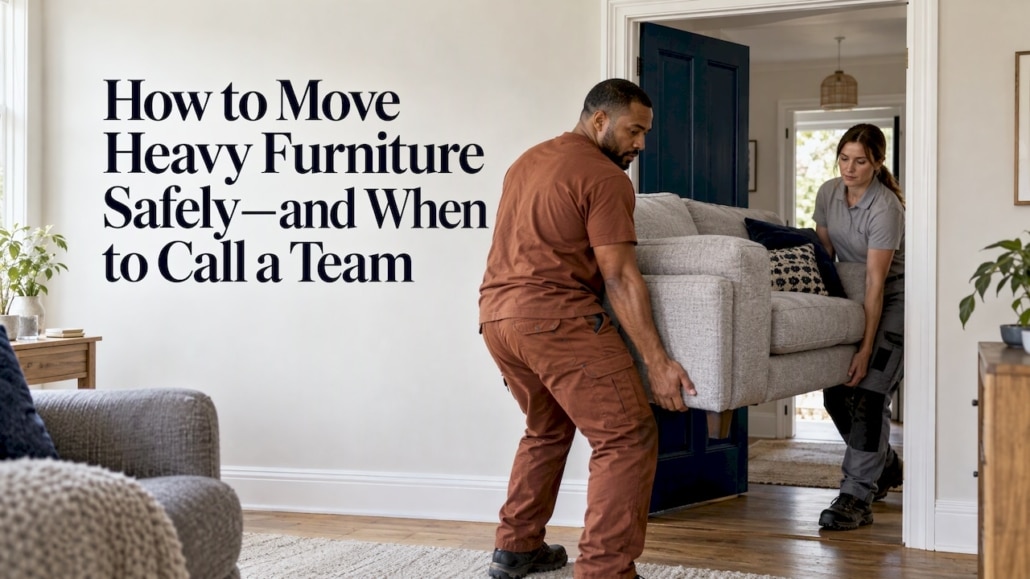
Heavy Furniture Moving: How to Do It Safely, and When to Call a Team
The safest way to move heavy furniture is to avoid lifting it alone: measure the route first, slide rather than lift where you can, take the item apart if it comes apart, and use at least two people for anything bulky. If a piece is too heavy, too tall or has to go down a tight staircase, a trained removals team is the sensible choice. This guide covers each step, the kit that helps, how to protect your floors and walls, and where the line sits between a job for friends and a job for professionals.
TL;DR
- Walk the route with a tape measure before anyone lifts: doorways, stairs, turns and the van or new room at the other end.
- Slide instead of lifting where you can, using sliders matched to the floor: hard ones for carpet, soft felt ones for hard floors.
- Treat anything over about 20 kg, or with two sides over 75 cm, as a two-person lift or a job for a trolley.
- Dismantle what is designed to come apart, and protect corners, floors and door frames before you start.
- Pianos, large wardrobes, safes and anything going up or down several flights are best left to a professional team.
Table of Contents
- Start with the question: does it need to be lifted at all?
- How heavy is too heavy?
- Plan the route before you touch the furniture
- Slide before you lift
- Lifting technique for the moments you cannot avoid
- Kit that makes heavy furniture easier
- Protect floors, walls and the furniture itself
- When to take it apart
- When to call professionals
- Perspective: why we always plan the heavy items first
- What to tell a removals company about large items
- Moving heavy furniture with Taylormade Removals
- Frequently asked questions
- Sources
Start with the question: does it need to be lifted at all?
The best lift is the one you do not do. Safe system of work guidance published by the CWU says that before any unfamiliar lifting task you should consider whether manual handling can be avoided by doing the job a different way, and carry out a dynamic risk assessment if it cannot.
At home, that translates into a few simple questions:
- Does the piece really have to move, or could it stay and the room be arranged around it?
- Can it be slid across the floor rather than carried?
- Can it be split into lighter parts (drawers out, shelves out, legs off, doors off)?
- Is there a trolley, strap or sack truck that does the carrying for you?
- Do you have enough people, and do they know what the plan is?
If the answer to the last question is no, the rest of this page matters even more.
How heavy is too heavy?
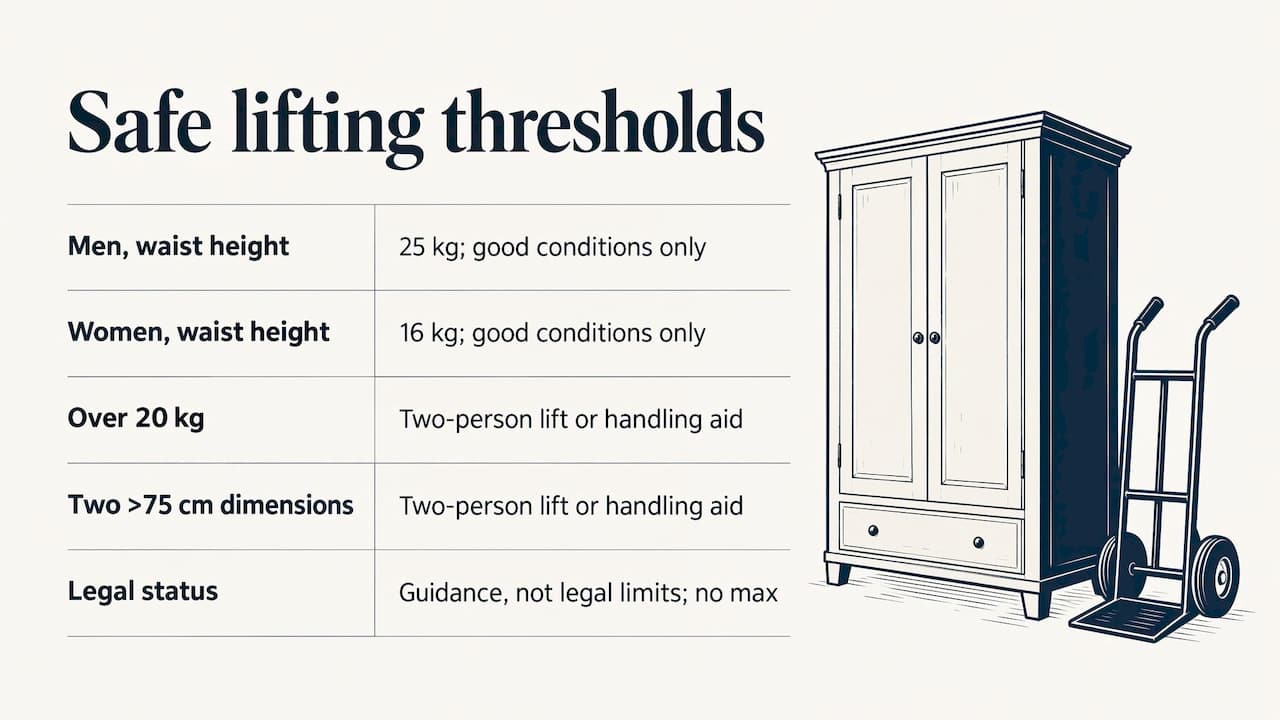
There is no single legal weight limit for lifting at home or at work. The Manual Handling Operations Regulations 1992 do not set a maximum weight, and HSE guideline figures of 25 kg for men and 16 kg for women apply to lifting at waist height in good conditions: load close to the body, stable, good footing, no twisting.
Those numbers are also narrower than they sound. They are guideline filter figures, not legal limits, and apply only in the single most favourable position: load held close to the body at about knuckle height, no twisting, no repetition. A wardrobe carcass on a staircase is nowhere near those conditions.
A practical rule from the same CWU document: for items over 20 kg, or with two dimensions over 75 cm, use a two-person lift or a handling aid such as a sack truck. Most sofas, chests of drawers, bookcases, mattresses, washing machines and dining tables meet at least one of those tests.
HSE’s revised 2025 manual handling guidance is reported to introduce a tiered risk assessment and new guidance on team lifting, including minimum team sizes for loads over 50 kg. Check the HSE site for the current wording if you are moving things for work.
The cost of getting it wrong is real. One materials handling company cites BUPA data that 80% of people suffer lower back pain at some point, and advises knowing your limits. If you have a back, shoulder or heart condition, or you are pregnant, speak to your GP before lifting anything heavy, and leave it to others.
Plan the route before you touch the furniture
Most damage and most near misses happen because a piece got stuck, not because it was too heavy to pick up. Ten minutes with a tape measure prevents both.
Measure the piece and the path
Measure the length, width and height of each large item, then measure every doorway, hallway, stair turn and the front door. It is far easier to take a door off its hinges than to force a sofa through a gap that does not quite fit.
One UK guide gives a useful benchmark: a standard internal door is around 76 cm wide, and the path should be at least as wide as the furniture plus 20 cm so hands and knuckles have room. Older properties in Chester and across North Wales often have narrower doors and tighter stair turns than newer builds, so measure rather than assume.
Clear the way
- Move rugs, shoes, pets and children out of the route.
- Prop doors open and take them off if needed.
- Remove pictures and mirrors from walls along the route.
- Check the destination: know exactly which room and which wall the item is going to, so nobody stands holding it while you decide.
- Plan where you will put the item down at each stage if someone needs to rest.
Empty and secure the furniture
Take everything out of drawers, cupboards and wardrobes. Tape or strap doors and drawers shut once empty. Loose contents add weight, shift mid-lift and are a common reason for dropped drawers.
Slide before you lift
Sliding changes the job. The Safety Elf explains that with pushing and pulling you are not taking the full weight of the load and can use your body weight, and that in general you should push rather than pull because your posture stays more neutral.
Choosing sliders for the floor
Sliders have a slippery side for the floor and a grippy or soft side for the item. The type matters:
| Floor | Slider type | Why |
|---|---|---|
| Carpet | Hard plastic sliders | Glide over the pile |
| Wood, laminate, vinyl, tile | Soft felt sliders | Spread the load and avoid scratching |
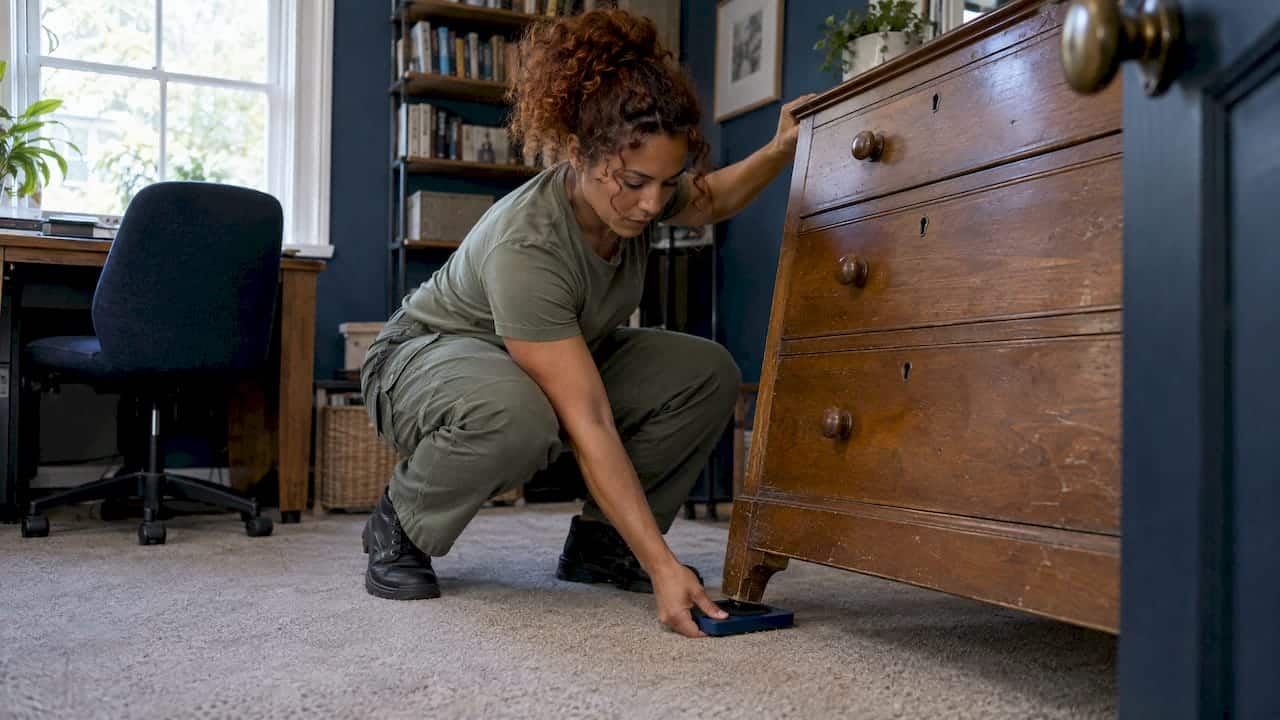
That pairing is set out by one UK supplier, and another UK guide suggests choosing sliders rated to at least 100 kg. Cardboard or folded blankets work as a stopgap on hard floors, but dedicated sliders are cheaper than a repaired floor.
Slide, do not drag
Sliders only help if the furniture is lifted off the floor at its corners first, one corner at a time, with the sliders placed underneath. Dragging a piece on its legs strains the joints. Museum handling guidance says furniture should be lifted directly off the floor rather than dragged, which strains the legs of the object. For a solid wood table or an older chest of drawers, that matters for the piece as much as for you.
Lifting technique for the moments you cannot avoid
Some lifts are unavoidable: onto a van, over a threshold, up a step. HSE guidance advises keeping the load close to the trunk, bending the knees, keeping the back straight and not twisting the trunk when turning. If you need to position something precisely, put it down first and then slide it into place.
In practice:
- Feet shoulder-width apart, one slightly forward, for a stable base.
- Bend the knees, not the waist, and keep the item hugged close.
- Lift with the legs and tell your partner when you are ready.
- Turn with your feet, never by twisting the spine.
- Take short steps. Taking short steps, avoiding rushing on uneven surfaces and resting regularly all reduce fatigue and the chance of injury.
- Lower slowly, bending the knees again.
Lifting as a pair
When a load is too heavy, bulky or awkward for one person, a team lift is the answer, and clear communication is what makes it safe. Agree before you start who leads, who walks backwards, and the words you will use: “ready, lift, stop, down”.
For tall pieces such as wardrobes and bookcases, one UK handling company suggests a high-low lift, with one person holding the top and another the base, for better control.
Two more habits worth adopting:
- Always pick furniture up by its lowest load-bearing part. Museum guidance warns never to use handles or fixtures to move it, because they may not be strong enough.
- Wear closed-toe shoes with good grip and, if you have one, work gloves. A US home improvement guide on dollies recommends sturdy footwear and gloves and testing an item’s weight before lifting it on or off.
Kit that makes heavy furniture easier
You do not need a van full of gadgets. A short list does most of the work:
- Furniture sliders for moving items across a room.
- A sack truck or four-wheel dolly for fridges, washing machines, boxed items and anything that can be tilted safely.
- Lifting straps that take some of the load through your legs and shoulders when used correctly by two people.
- Moving blankets and stretch wrap to protect surfaces and keep doors and drawers closed.
- A tape measure, screwdriver set and sealable bags for hardware.
None of this replaces judgement. If a trolley needs the item balanced on a narrow edge down a flight of stairs, it is the wrong tool for that job.
Protect floors, walls and the furniture itself
Heavy furniture damages property in predictable ways: scuffed skirting, gouged door frames, torn carpet pile, dented laminate. A few habits prevent most of it:
- Put felt pads or cardboard under every contact point on hard floors, hard sliders on carpet, and double up blankets on tiles. A folded towel over the metal strip at doorways stops it catching.
- Wrap corners with towels or bubble wrap, and use blankets to stop furniture scratching walls as it goes past.
- Take care with older and antique pieces: museum guidance notes that most damage to furniture happens during movement and handling, and advises moving it as little as possible.
- Remove glass shelves, mirrors and loose tops and move them separately.
- Protect door frames and banisters with blankets taped on, not tied tightly.
If you are a tenant, remember a damaged floor or a marked wall can affect your deposit. If you are leaving a property, our end of tenancy clearance service can take unwanted bulky pieces off your hands, so you are not trying to manoeuvre a sofa you do not even want.
When to take it apart
Flat-pack wardrobes, beds, bookcases, desks and many dining tables are designed to be dismantled, and doing so cuts weight and bulk dramatically. A sensible approach:
- Photograph the piece before you start, so reassembly is easy.
- Take off doors, drawers, shelves, legs and headboards.
- Keep every screw, cam lock and dowel in a labelled bag, taped to the main part.
- Wrap each component and label it with the room it belongs in.
- Check you have the right tools for reassembly at the other end, and that you can get at them.
Do not dismantle what is not designed to be dismantled. Glued, dowelled or antique furniture can be weakened by being pulled apart. Leather sofas with fixed frames, solid hardwood wardrobes and old pieces with brittle joints are better moved whole, with proper handling, or by people who do this every week.
When to call professionals
Do-it-yourself works for a bookcase and a spare weekend. It stops working when one of these applies:
- The piece is very heavy or very large: American wardrobes, solid oak sideboards, large corner sofas, snooker tables, safes, gym equipment.
- There are several flights of stairs, tight turns, or a flat with no lift.
- The access is poor: narrow doors, awkward parking, steep driveways, a long carry.
- The item is valuable or fragile: antiques, pianos, marble-topped pieces, glass cabinets.
- You cannot get enough capable helpers or anyone has an existing back or joint problem.
- You are on a deadline, or a whole house or office is moving at once.
Even a well-known DIY retailer says that moving heavy furniture on your own is not recommended even with tools. It is the same reason professionals work in teams with trained handling and the right kit.
Pianos deserve a special mention
Upright and grand pianos combine huge weight, an awkward centre of gravity and delicate internals. They are not a job for a group of friends and a hired trolley. We have written a full guide on moving a piano safely in Chester.
If the move is soon
Sometimes the date arrives faster than the plan. If you are short of time, our guide on how to organise a last-minute move covers what to prioritise, and large pieces should be the first thing you flag to the removals team.
Perspective: why we always plan the heavy items first
After more than 20 years of removals in Chester, Wrexham and the surrounding areas, we have learned that the heaviest piece in the house rarely causes the problem on its own. What causes trouble is a piece nobody measured, a staircase nobody walked, or a helper who was never told the plan.
That is why careful handling comes first for us. Each item is treated with care during loading, transporting and unloading, and heavy furniture is no different: we look at the route, protect the floors and the piece, and decide who does what before anything is lifted. Where a piece has to be taken apart, we do it deliberately, keep the fittings together and put it back together at the other end.
If you are moving a large wardrobe, a heavy sofa or a piano, tell us about it when you ask for a quote, including the stairs, the doorways and the parking. It lets us send the right team and equipment, and turns a stressful part of moving day into a routine one.
the author
What to tell a removals company about large items
The better the briefing, the smoother the day. When you contact a removals company, give them:
- A list of the biggest and heaviest pieces, with approximate dimensions.
- The number of floors and stairs at both addresses, and whether there is a lift.
- Notes on parking and distance from the front door to where the van can stand.
- Anything that has to be dismantled, and whether it has been done already.
- Any piece you think might not fit through a door, window or stairwell.
- Whether you want packing for fragile items, and whether any furniture needs to go into storage between homes.
Booking early is a recurring tip in guidance on moving large or awkward items, as is telling the company about them in advance, because they affect the crew size and the vehicle.
Moving heavy furniture with Taylormade Removals
If you are in Chester, Wrexham, Cheshire or North Wales and would rather not carry a wardrobe down a staircase yourself, our team can handle it. We provide home removals, packing, large item removals and piano removals, all with the same focus on careful handling and a personal service, and we are fully insured.
You can read about our home removals service, or go straight to the local pages for Chester and Wrexham. If you are between homes or renovating, our storage solutions give large furniture somewhere safe to wait. Get in touch for a tailored quote.

Frequently asked questions
How do you move furniture that is too heavy to lift?
Slide it rather than lift it, using sliders that suit your floor, and remove drawers, doors, shelves and legs to cut the weight. Use a trolley or strap for items that can be tilted safely, and get a second person for any lift. If it is still too much, a professional removals team is the safest choice.
What can I put under heavy furniture to move it?
Furniture sliders are the standard answer. Hard plastic ones suit carpet and soft felt ones suit hard floors such as wood, vinyl and tile. Lift one corner at a time to place them, and check they are rated well above the weight of the piece.
How many people do you need to move a heavy wardrobe?
At least two, and often more with a full-size or solid wood wardrobe. Guidance says moving furniture usually needs at least two people even for small items. Empty it, take off doors and shelves if it is designed to come apart, and agree your signals before lifting.
Is there a legal weight limit for lifting furniture?
No single limit exists. The 1992 regulations set no maximum weight, and the 25 kg and 16 kg figures are guidelines for ideal conditions only. Stairs, awkward shapes and twisting make a much lighter load risky.
Should I dismantle furniture before a move?
Yes, if it is designed to be dismantled, as it makes the pieces lighter and easier to carry. Photograph it first and bag the fittings. Leave glued, antique or fragile joints alone and have them handled whole by people with experience.
Sources
- HSE: Health and safety in engineering workshops (HSG129)
- National Museums Scotland: handling guidelines
- CWU: Manual handling safe system of work
- Health & Safety News: HSE manual handling guidance for 2025
- KeyOstas: Manual Handling Regulations 1992
- KC Supply: manual handling equipment and regulations
- Praxis42: manual handling lifting techniques
- BIL Group: how to move heavy furniture safely
- Dako Home: moving heavy furniture safely and easily
- The Safety Elf: furniture sliders
- Evo Supplies: what to put under heavy furniture
- This Old House: using a moving dolly
- SofaFox: moving furniture without scratching floors
- The Home Depot: how to move heavy furniture


Leave a Reply
Want to join the discussion?Feel free to contribute!