


Storage in Wrexham: Options, Sizes, Costs and What to Check
Storage in Wrexham comes in a few forms: self-storage units, steel containers, vehicle storage, and storage run alongside a removals company. The right one depends on how long you need it, how much you are keeping, and whether you want to carry everything yourself. This guide explains how to pick a size, what drives the price, what to read in the rental terms, and how our own storage fits when you are mid-move, renovating or downsizing.
TL;DR
- Work out what you are storing first: a room’s contents, a whole house or business stock. That sets the size, and the size sets most of the price.
- Across the UK the average self-storage rent was £29.13 per sq ft in 2024, with Wales just over £20 per sq ft, so local prices tend to sit below the national figure.
- Before you sign, check access hours, insurance, security, notice periods and what happens to the price after any introductory period.
- If storage is part of a move, booking it with the removals team saves a second set of loading, lifting and transport.
- We offer residential and commercial storage in Wrexham and across Cheshire and North Wales. Ask us about storage for a tailored quote.
Table of Contents
- Which kind of storage suits your situation
- Types of storage you will come across
- Choosing the right size
- What storage costs in Wrexham
- What to check before you sign
- Storage when you are moving house
- Storage for businesses
- Perspective: why we treat storage as part of the move
- Our storage in Wrexham
- A simple plan for finding storage
- FAQ
- Sources
Which kind of storage suits your situation
People search for storage in Wrexham for very different reasons, and the sensible option changes with each.
Between homes. A sale and a purchase rarely complete on the same day. Belongings go into storage for a few days or a few weeks until the keys to the new place arrive. Here, the handover between the removal van and the storage space matters more than the unit itself.
During renovation. A kitchen refit or an extension means furniture has to leave the rooms entirely. Short, predictable storage works well, and you want to know the date your things can come back.
Downsizing. Moving to a smaller home often means more belongings than space. Storage gives you time to decide what stays, what goes to family and what is cleared, rather than making rushed decisions in the last week.
Student, tenancy and landlord gaps. Tenants between lets and landlords turning a property round often need a few months of space for furniture and boxes.
Business needs. Offices and small firms store archive files, spare furniture after a downsize, display stock or equipment between sites. Commercial storage often runs for longer than household storage, so the terms matter more.
Vehicles and large items. Caravans, motorbikes, classic cars and trade vehicles are usually stored in dedicated indoor or outdoor spaces, which is a separate market from household storage. If you are looking for that, ask any provider specifically whether vehicles are accepted before visiting.
Types of storage you will come across
It helps to know the vocabulary before you start phoning around.
| Type | How it works | Often suits |
|---|---|---|
| Self-storage unit | An indoor room you rent and access yourself | Household contents, business stock, archives |
| Steel container | A lockable shipping-style container, commonly 20ft by 8ft, on a secure site | Larger loads, longer-term or bulky items |
| Removals-company storage | Your belongings are collected, stored and delivered back by the same team | Moves, renovations, downsizing |
| Vehicle storage | Indoor or outdoor space for cars, caravans and trade vehicles | Seasonal or long-term vehicle parking |
Self-storage is a mature market. The 2025 industry report from Cushman & Wakefield for the Self Storage Association UK surveyed 70 companies running 760 stores, covering over 60% of UK self-storage space, and found industry occupancy at 75.1%. In plain terms, lots of people use storage, and units in popular sizes can be in demand, so it pays to enquire a little before the date you need space.
Choosing the right size
The most common mistake is picking by guesswork. Too small and you pay twice when you have to upgrade. Too large and you pay for air.
Start from what is in your home, not from the unit sizes on offer.
- List the big items. Sofas, beds, wardrobes, a dining table, a fridge-freezer. These take up the floor area.
- Count the boxes. A typical household rarely has fewer than 30 to 50 boxes once books, kitchenware and clothes are packed. Uniform boxes stack to the ceiling and use space efficiently.
- Allow for access. If you will need to reach items during the rental, leave a walkway rather than packing wall to wall.
- Think vertically. Heights matter. Disassembled furniture, sofas stood on end and shelving let you use the full height of the space.
As rough guidance, a few boxes and small furniture suit a small locker-style space. One or two rooms of furniture suit a mid-sized unit. A full three-bedroom house contents often need a container-sized space, the sort of 20ft by 8ft footprint seen at local container sites. Where a provider offers it, a quick description of your belongings is often enough for them to recommend a size.
If you are storing through us, the team that will load your belongings can look at what you have and advise on how much space it needs, because they handle the packing and loading themselves.
Packing for storage
Well-packed storage uses less space and protects your things for longer.
- Use sturdy boxes of matching sizes and put heavy items in small boxes.
- Wrap furniture in blankets or covers, and take legs off tables where you can.
- Keep upholstered items off the floor on pallets or on top of other furniture.
- Label every box with the room and contents, and keep a simple inventory.
- Leave a little air space around items rather than sealing them tight against walls.
If you would rather not do this yourself, our packing service is part of our home removals offer.
What storage costs in Wrexham
Prices vary by provider, size, length of rental and time of year, and most operators publish only starting rates or ask you to contact them for a quote. The best way to compare is to ask each for the full monthly cost for the same size and the same period.
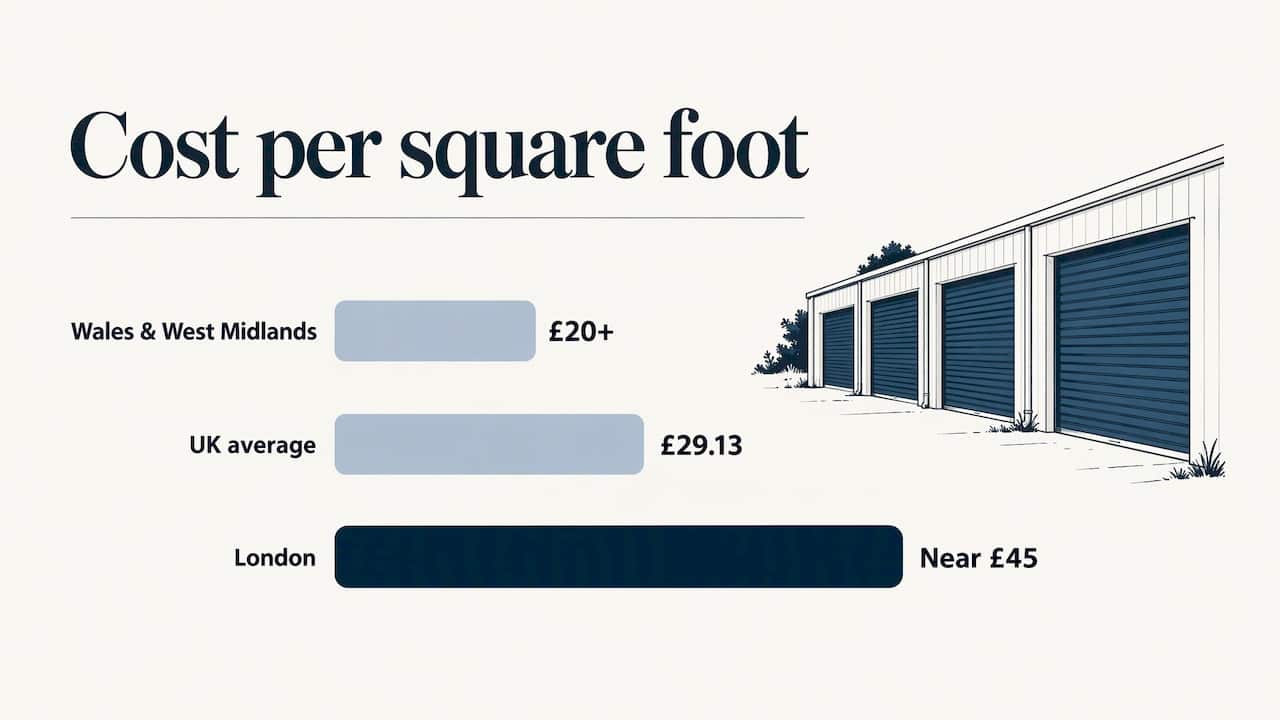
For context, Which? reports, drawing on the Self Storage Association UK’s 2025 report (2024 data), that the average cost of renting a self-storage unit in the UK was £29.13 per square foot. It was lowest in the West Midlands and Wales at just over £20 per sq ft, and highest in London at nearly £45 per sq ft. Those are industry averages, not a quote for any one unit, but they show that North Wales is among the more affordable areas in the country. The same industry report found revenue per square foot up 6% year on year, so rates have been trending upwards.
What moves the price
- Size. Larger spaces cost more in total, though often less per square foot.
- Length. Longer commitments can be priced differently from short ones. Ask how the price is set for your period.
- Location and access. Sites on main roads close to town may cost differently to rural ones.
- Features. Indoor rooms, loading access, heating and security arrangements can all affect cost.
- Insurance. Cover is often charged separately by the month.
- Introductory offers. A low first-month rate is useful, but ask what the standard rate is afterwards.
Our storage is quoted to the job, because the space, the length of stay and whether we are also moving your belongings all differ. We do not publish a fixed price list, so the quickest route is to get in touch for a tailored quote.
What to check before you sign
A short checklist saves most storage regrets. Ask these questions of any provider, ourselves included.
Security and access
Find out how the site is secured, who can get in, and when you can get to your belongings. Some sites have fixed hours, others give wider access. If you expect to visit often, access hours matter as much as price. Ask whether you hold the only key or code to your space.
Insurance
Do not assume your home contents policy covers items kept elsewhere. Some policies limit cover for belongings outside the home, or only for a set number of days. Phone your insurer, tell them the items, the site and the length of rental, and get the answer in writing. For business stock, check that your commercial policy covers goods held off-premises. If the provider offers cover, ask what the limits are and which items are excluded, for example cash, jewellery and important documents are commonly excluded.
Notice periods and rolling terms
Most rentals roll on until you give notice. Check how much notice is required, whether you pay for a full month when you leave part-way through, and whether there is a minimum term. Check also whether the price can change during the rental and how you will be told.
Short-term versus long-term
Short-term storage, a few weeks around a house move, suits flexible terms, and you want to know the cost of extending if completion slips. Long-term storage, months or years, is where notice periods, price reviews and the condition of the space matter more. Occupancy and turnover figures in the industry report suggest many renters stay a long while: it reports that mature stores average 79% occupancy, so a rental that starts as temporary can easily become permanent. Decide at the start roughly how long you need and tell the provider.
What can and cannot be stored
Every provider has a list of prohibited items, typically including hazardous materials, fuel, gas bottles and perishable food. Ask for the list before you pack, and never store anything you cannot legally keep.
Condition of the space
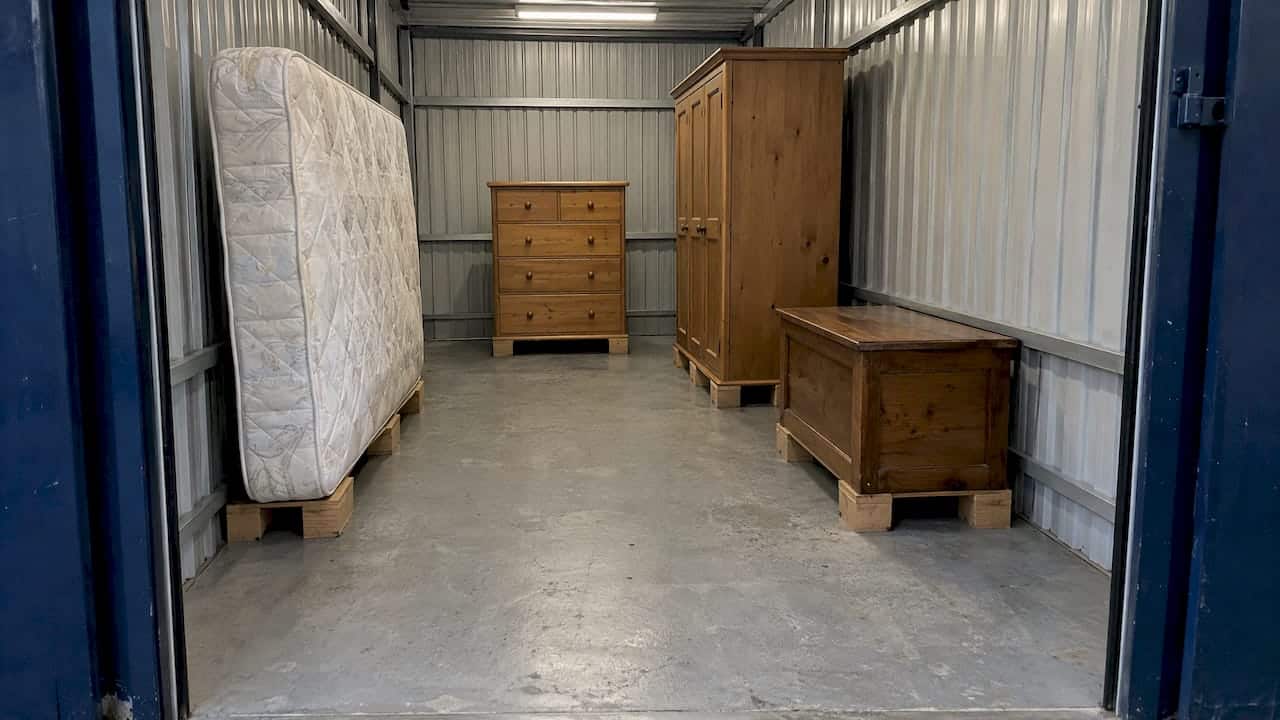
Look for a dry, clean space. Keep fabrics, mattresses and wooden furniture off the floor and allow some airflow, particularly over winter.
Storage when you are moving house
If storage is part of a move, the simplest approach is one team handling everything. That means the same people load the van, drive, and place your belongings into storage, and later bring them out again for delivery to your new address.
A typical sequence looks like this:
- Survey or call. Describe your home, the access at both ends and when you need storage to start.
- Packing. You pack, or we do. Fragile and high-value items are handled with extra care.
- Loading. Furniture is protected and loaded in a planned order.
- Storage. Your belongings go into storage for the agreed period.
- Delivery. When you are ready, we bring them to your new address and place them where you want them.
If your timetable is tight, see our guide on how to organise a last-minute move. If you are moving in the Wrexham area, our Wrexham home removals page explains how we work locally.
Storage for businesses
Commercial storage in Wrexham is often tied to a change: an office downsize, a relocation where the new premises are not ready, or a refit. In those cases, the same planning that makes an office move run smoothly applies to storage: label by department, record what goes in, and agree in advance who may collect items.
If you are moving premises as well, our office removals in Wrexham service is project-managed to keep disruption low, and we also provide commercial storage for furniture, files and equipment that has to be held for a time. Our wider commercial removals page covers the options.
Perspective: why we treat storage as part of the move
Most people come to us thinking of storage as a separate problem to solve, a unit to find and a van to organise. In our experience across more than 20 years of moving people and businesses around Wrexham, Chester and North Wales, it works best as part of one plan.
When the people who pack your belongings are the same people who load, store and later deliver them, there are fewer handovers and fewer places for things to go wrong. We treat each item with care at every stage because we know we will be the ones carrying it back out.
Our storage is designed to be flexible, for customers going through transitions such as renovations or downsizing, and for businesses that need space while premises change. We would rather understand your timetable, how much you have and how often you may need access, and then shape the arrangement around that, than ask you to fit a fixed package.
That is also why we quote to the job. Your belongings, your dates and your property are specific, and the quote should be too.
the author
Our storage in Wrexham
We provide residential and commercial storage for customers in Wrexham, Chester, Cheshire and North Wales. It is flexible by design, so it can cover a few weeks between completions, the months of a renovation, or longer while you decide what to keep after downsizing. You can use it on its own or alongside our removals, packing and house clearance services, and we are fully insured.
Tell us what you are storing, roughly how long you need it and where it has to go afterwards, and we will put a quote together.

See our storage solutions page for details, or visit our main site to get in touch.
Clearing before you store
Storage is easiest to manage when you only keep what you need. If you are downsizing or dealing with a relative’s home, our house clearance service can deal with unwanted items responsibly, so you only pay to store what you are keeping.
A simple plan for finding storage
- Decide the start date and a realistic end date.
- List and measure the biggest items, and estimate your box count.
- Ask two or three providers for the monthly total for the same size and length, including insurance.
- Check access hours, security, notice terms and prohibited items.
- Confirm with your own insurer in writing.
- Pack, label and keep an inventory.
- Diarise a review date, so a short-term rental does not drift on unnoticed.
FAQ
How much does storage cost in Wrexham?
It depends on the size, length and type of space, and most providers quote on request. As a benchmark, the UK average was £29.13 per sq ft in 2024, with Wales just over £20 per sq ft, according to Which?. Ask for the full monthly cost including insurance.
What size storage do I need for a one-bedroom or three-bedroom home?
Count your large furniture and boxes, then allow for walkway space. A flat’s contents generally need a mid-sized space, while a family house often needs a container-sized one. Tell your provider what you have and ask for their recommendation.
Is my stuff covered by my home insurance while in storage?
Not necessarily. Some policies exclude items outside the home or limit the number of days covered. Call your insurer with the details of the items, the site and the length of stay, and get confirmation in writing.
Can you store my belongings and move them for me?
Yes. We provide flexible residential and commercial storage along with removals, packing and clearances, so one team can collect, store and deliver. Contact us through our storage page for a quote.
Can I store a vehicle in Wrexham?
There are dedicated indoor and outdoor vehicle storage options in the Wrexham area, and they are generally separate from household storage. Ask any provider directly whether vehicles are accepted and what security is in place. We focus on household and commercial belongings.
Sources
- Self-storage: how much it costs, and how to save money (Which?)
- Self Storage Report 2025 (Cushman & Wakefield for the Self Storage Association UK)


Leave a Reply
Want to join the discussion?Feel free to contribute!